The Short Version
There’s no universally “best” data warehouse. The right choice depends on your team’s skills, your workload patterns, your cloud provider, and what you’re actually trying to do with your data.
Quick decision framework:
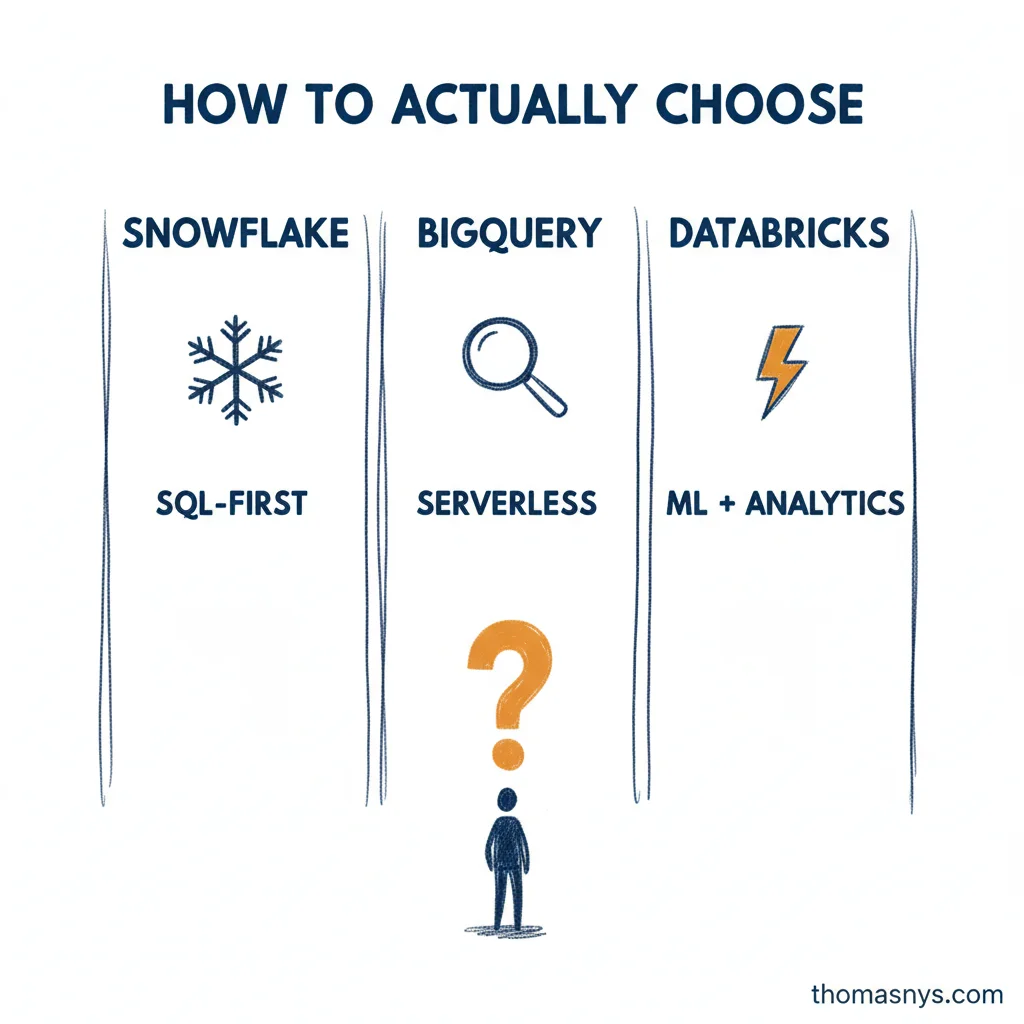
- BigQuery if you’re already on GCP, want zero infrastructure management, and your workloads are primarily analytics and BI. Lowest operational overhead.
- Snowflake if you’re multi-cloud or cloud-agnostic, want strong data sharing capabilities, and your team values a polished SQL-first experience. Most predictable scaling.
- Databricks if you need unified analytics and ML/AI workloads, your team is comfortable with Spark, and you’re building a lakehouse with heavy data science. Best for combined analytics + ML.
But here’s what most comparison articles won’t tell you: the platform rarely makes or breaks your data strategy. I’ve seen companies succeed on all three and fail on all three. The failures almost always trace back to governance gaps, unclear ownership, or trying to solve an organizational problem with a technology purchase.
Comparison Table
| Dimension | Snowflake | BigQuery | Databricks |
|---|---|---|---|
| Architecture | Shared-nothing, multi-cluster | Serverless, Dremel engine | Lakehouse (Delta Lake + Spark) |
| Pricing model | Compute credits + storage | Per-query (on-demand) or slots | DBUs (Databricks Units) + storage |
| Cost predictability | Medium - depends on warehouse sizing | High (slots) or Low (on-demand) | Medium - depends on cluster config |
| SQL experience | Excellent - native SQL first | Excellent - ANSI SQL | Good - SQL via Spark SQL |
| ML/AI workloads | Limited (Snowpark) | Good (BigQuery ML, Vertex AI) | Excellent (MLflow, notebooks, Unity Catalog) |
| Data sharing | Best-in-class (Snowflake Marketplace) | Good (Analytics Hub) | Growing (Delta Sharing) |
| Multi-cloud | Yes (AWS, Azure, GCP) | GCP only (with BigQuery Omni for cross-cloud queries) | Yes (AWS, Azure, GCP) |
| Governance | Good (roles, masking, tagging) | Good (IAM, column-level security) | Excellent (Unity Catalog) |
| Streaming | Limited (Snowpipe) | Good (BigQuery real-time) | Excellent (Structured Streaming) |
| Ideal team | SQL analysts + data engineers | SQL analysts + minimal ops | Data engineers + data scientists |
| Operational overhead | Low - managed service | Lowest - fully serverless | Medium - cluster management needed |
| Startup cost | Medium | Low (free tier + on-demand) | Medium-High |
When to Choose Snowflake
Snowflake works best for organizations that:
- Need a strong SQL-first analytics platform where analysts can self-serve
- Operate multi-cloud or might switch cloud providers
- Value data sharing with partners, customers, or across business units
- Have a team of SQL-proficient analysts and data engineers
- Want predictable performance without tuning clusters
Where Snowflake shines: The separation of storage and compute is genuinely well-implemented. You can scale compute independently, and the virtual warehouse model is straightforward. Data sharing through Secure Data Sharing and the Marketplace is ahead of competitors.
Where Snowflake struggles: ML/AI workloads feel bolted on (Snowpark is improving but isn’t native). Costs can surprise you if you don’t manage warehouse auto-suspend and sizing carefully. Real-time/streaming is limited compared to Databricks.
Cost reality for a 50-person scaleup: Expect $2,000-8,000/month depending on query volume and warehouse sizing. The credit model is straightforward but requires monitoring.
When to Choose BigQuery
BigQuery works best for organizations that:
- Are already invested in Google Cloud Platform
- Want the lowest operational overhead possible
- Have workloads that are primarily analytics and BI
- Prefer a pay-per-query model for unpredictable usage patterns
- Have a lean team that can’t dedicate resources to platform management
Where BigQuery shines: Truly serverless - there’s nothing to manage, no clusters to size, no warehouses to configure. Just write SQL and get results. The pricing model (especially flat-rate slots) can be very cost-effective for consistent workloads. Integration with Google’s ML ecosystem (Vertex AI, BigQuery ML) is seamless.
Where BigQuery struggles: You’re locked into GCP. While BigQuery Omni offers cross-cloud queries, it’s not the same as running natively on AWS or Azure. On-demand pricing can get expensive fast with undisciplined querying (I’ve seen teams blow through $10K in a month because analysts ran SELECT * on large tables). Less ecosystem flexibility than Snowflake for data sharing.
Cost reality for a 50-person scaleup: On-demand can range wildly ($500-15,000/month). Flat-rate slots ($1,700/month for 100 slots) give predictability. For most scaleups, flat-rate is the smarter choice once you hit consistent usage.
When to Choose Databricks
Databricks works best for organizations that:
- Need unified analytics and ML/AI on one platform
- Have data engineers and data scientists comfortable with Spark/Python
- Are building a lakehouse architecture with Delta Lake
- Need real-time streaming alongside batch analytics
- Want the most flexibility in how they process and serve data
Where Databricks shines: If you’re doing serious ML/AI work alongside analytics, nothing else comes close to the integrated experience. Notebooks, MLflow, feature stores, model serving - it’s all there. Unity Catalog has made governance genuinely good. Delta Lake gives you reliability guarantees on top of open file formats.
Where Databricks struggles: It’s more complex to operate than Snowflake or BigQuery. Cluster sizing, auto-scaling configuration, and cost management require attention. SQL analysts who just want to write queries may find the environment less polished than Snowflake. The learning curve is steeper.
Cost reality for a 50-person scaleup: $3,000-12,000/month depending on cluster configurations and workload mix. DBU pricing is harder to predict than Snowflake credits or BigQuery slots. The serverless SQL warehouses have improved this significantly.
The Mistakes I See Most Often
After 10+ years of advising on platform decisions, these are the patterns that consistently lead to regret:
1. Choosing based on features you’ll never use
A 30-person company picking Databricks because “we’ll need ML eventually” when their current need is dashboards and basic reporting. Start with what you need now. Migration between platforms, while not trivial, is manageable if your architecture is clean.
2. Ignoring the team you actually have
If your team is 5 SQL analysts and 1 data engineer, Databricks is probably the wrong choice regardless of its technical merits. Snowflake or BigQuery will get you to value faster because your team can be productive immediately.
3. Letting the vendor decide
Every vendor will tell you their platform is the right one. That’s their job. An independent assessment that starts with your actual requirements - not a demo of features - will save you from expensive mistakes. A data architecture consultant who doesn’t have vendor partnerships can help you evaluate objectively.
4. Treating this as a permanent, irreversible decision
If your data architecture is well-designed - clean data models, documented transformations, proper data governance - switching platforms is a 3-6 month project, not a multi-year rewrite. Don’t over-agonize the initial choice.
5. Skipping the cost model analysis
Run a realistic cost projection for 12 months. Not the vendor’s optimistic “getting started” estimate - a projection based on your actual data volumes, query patterns, and growth rate. I’ve seen annual cost differences of 3-5x between platforms for the same workload.
Decision Framework
Ask these questions in order:
1. What cloud provider are you on? If you’re all-in on GCP → BigQuery gets a strong advantage (integration, networking, no egress costs). If multi-cloud or cloud-agnostic → Snowflake or Databricks.
2. What does your team look like? Mostly SQL analysts → Snowflake or BigQuery. Mix of engineers and data scientists → Databricks. Small team, minimal ops capacity → BigQuery.
3. What are your workloads? Primarily BI/analytics → Snowflake or BigQuery. Analytics + ML/AI → Databricks. Heavy streaming + batch → Databricks.
4. How important is data sharing? Critical for business → Snowflake. Nice to have → Any platform.
5. What’s your budget model? Need predictable monthly costs → BigQuery (flat-rate) or Snowflake (with guardrails). Want pay-per-use flexibility → BigQuery (on-demand). Can invest in optimization → Databricks.
My Honest Take
For most startups and scaleups I work with (10-200 people, Series A-C), the decision usually comes down to BigQuery vs Snowflake. Most don’t need Databricks yet - and by the time they do, they’ll know it.
Between BigQuery and Snowflake, the deciding factor is usually your cloud provider and your team’s comfort level. If you’re on GCP, BigQuery is the path of least resistance. If you’re on AWS or Azure (or might switch), Snowflake gives you more flexibility.
But here’s what actually matters more than the platform choice: Do you have someone who can design the architecture that sits on top of it? The best platform with bad architecture will underperform a mediocre platform with good architecture. Every time.
If you’re facing this decision and want a platform-independent perspective, an architecture advisory session can help you evaluate options against your specific requirements, team capabilities, and growth trajectory. No vendor partnerships, no commissions - just an honest assessment.