4-6 weeks to resolve team friction that’s been dragging on for months. Clear ownership, fewer escalations.
Who This Is For
Organizations where data, product, and ops all depend on the platform - but don’t agree on ownership or priorities.
You might recognize these patterns:
- “Who owns this?” comes up in every incident
- Requests bounce between teams for weeks
- Same discussions happen repeatedly with no resolution
- Teams optimize locally while the whole system suffers
- Urgent escalations are the default, not the exception
- Nobody’s wrong, but nothing gets better
These aren’t people problems. They’re system problems.
The fix isn’t better individuals. It’s clearer rules for how work flows.
What Usually Triggers This
- Post-incident retrospectives keep identifying the same coordination gaps
- A reorganization left ownership unclear and nobody wants to claim responsibility
- Growth added teams faster than processes could keep up
- Leadership change - new Head of Data or CTO wants to reset how teams work
- Chronic frustration finally hit a breaking point (“we can’t keep working like this”)
If you’ve tried to fix this with meetings, Slack channels, or documentation and it hasn’t worked - the problem isn’t communication. It’s missing structure.
What This Is
An intensive sprint focused on how people work around the data platform - not just the technology.
I facilitate. Your teams decide and own the outcome.
Stakeholder Interviews
Map expectations, pain points, and responsibilities across teams.
- What does each team think they own?
- What do they think other teams own?
- Where do gaps and overlaps create friction?
Ownership Workshops
Clarify who owns what and where handoffs happen.
- Which decisions belong to which team?
- What requires coordination vs what can move independently?
- Where does authority live when there’s conflict?
SLAs and Rituals
Define how teams work together.
- What response times are expected?
- What meetings actually need to happen?
- What can be async?
Lightweight Governance
Structure that fits your culture - not bureaucracy for its own sake. (See What Is Data Governance? for context.)
- Minimum viable process
- Clear escalation paths
- Decision rights documented
How It Works
| Aspect | Details |
|---|---|
| Duration | 4-6 weeks |
| Intensity | 2-3 days per week |
| Approach | Interviews → workshops → documentation → adoption |
Why this duration? Alignment needs discovery, facilitation, and a short adoption window to make new ownership stick.
The Investment
Team friction has real costs - but they’re often invisible until you add them up.
| Hidden Cost | What It Looks Like |
|---|---|
| Escalation overhead | Senior leaders pulled into operational disputes |
| Duplicate work | Teams solving the same problem separately |
| Delayed delivery | Work stuck waiting for unclear handoffs |
| Attrition | Good people leave friction-heavy environments |
A 4-6 week sprint costs less than one quarter of unresolved team friction - and far less than losing a senior engineer to frustration.
The Sprint Structure
Weeks 1-2: Discovery
- 1:1 interviews with key stakeholders
- Map current state of ownership and handoffs
- Identify friction points and root causes
Output: Clear picture of where alignment breaks down and why.
Weeks 3-4: Design
- Facilitated workshops with cross-functional groups
- Draft ownership boundaries and decision rights
- Define SLAs and escalation paths
Output: Working documents your teams actually agree on.
Weeks 5-6: Adoption
- Socialize decisions with broader team
- Run first iteration of new rituals
- Adjust based on early feedback
Output: New ways of working that stick.
What You Get
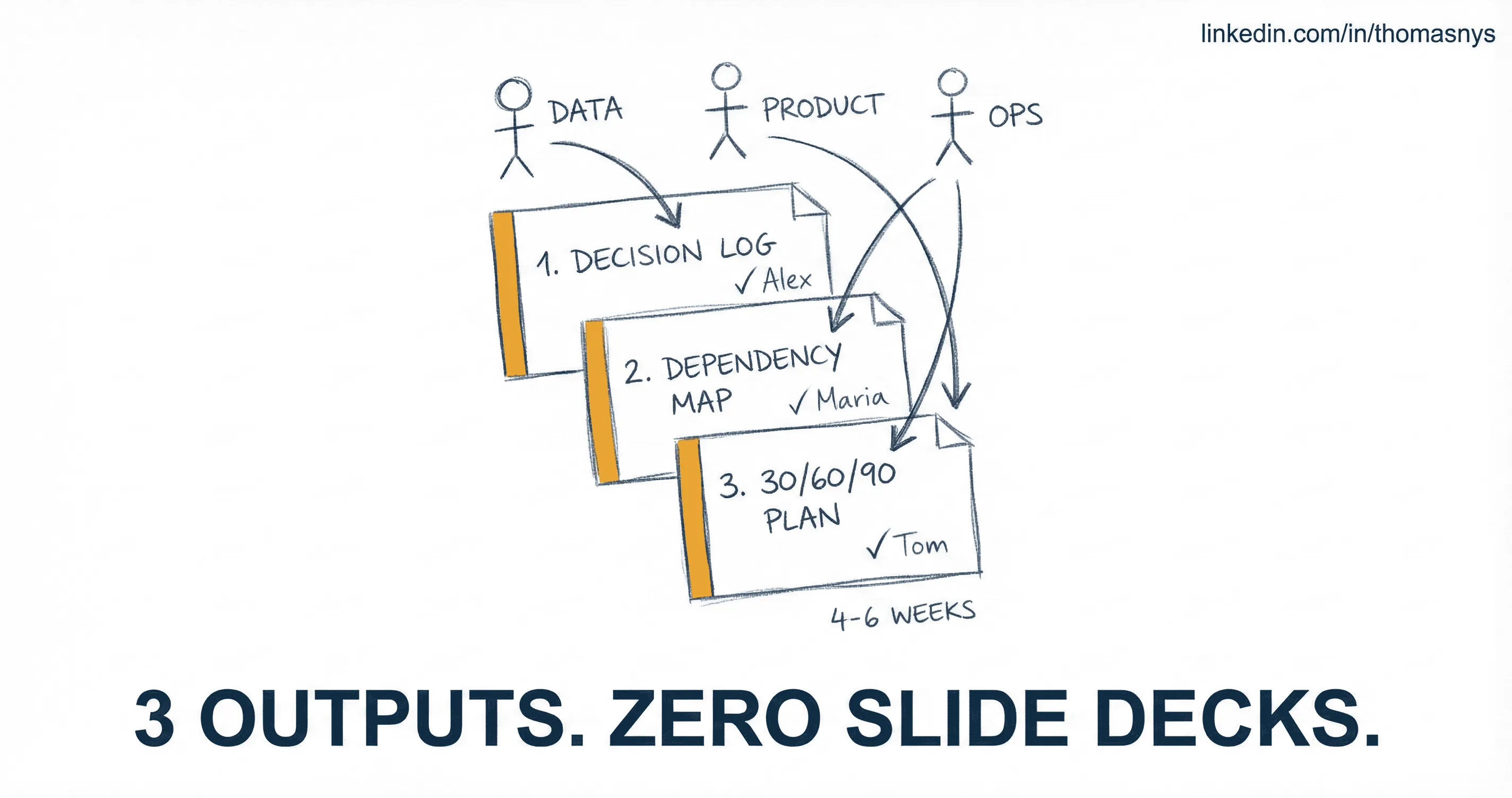
Three working documents your team will actually use:
1. Decision Log
Who owns what decisions. How conflicts escalate. Where authority lives.
- Updated weekly during sprint
- Becomes living reference after
2. Dependency Map
Communication map showing:
- Which teams need to talk before which changes
- Where handoffs happen
- What breaks when coordination fails
Updated monthly after sprint.
3. 30/60/90-Day Plan
Specific outcomes with names attached:
- What changes in 30 days
- What changes in 60 days
- What changes in 90 days
Reviewed biweekly with owners accountable.
What Changes After
- Fewer drive-by requests - Clear ownership means requests go to the right place first
- Fewer urgent escalations - Problems get caught before they become emergencies
- Clearer responsibilities - Data, product, and ops know their lanes
- Teams ship without stepping on each other - Autonomy within defined boundaries
When This Makes Sense
| Situation | Why Sprint Helps |
|---|---|
| Growing pains | Teams scaled but coordination didn’t |
| Post-reorg | New structure needs new rules |
| Chronic friction | Same conflicts keep recurring |
| Platform becoming shared | Multiple teams now depend on same infrastructure |
| Before major initiative | Get alignment before starting, not during |
What This Is Not
Want ongoing architecture support? → Fractional Data Architect
Related Thinking
- Team Alignment Sprint: 3 Outputs Teams Actually Use
- Data Quality as Shared Responsibility
- Communication Debt Becomes Technical Debt
- Team Structure Shapes Delivery Speed
Related Services
- Platform Review - When technical issues compound the friction
- Hiring & Team Support - Scale your team with clear roles
Frequently Asked Questions
Frequently Asked Questions
What if people don't want to participate?
Will the changes actually stick?
What if the problem is actually technical, not organizational?
Dealing with team friction?
Book a 30-minute call to discuss whether an alignment sprint could help.