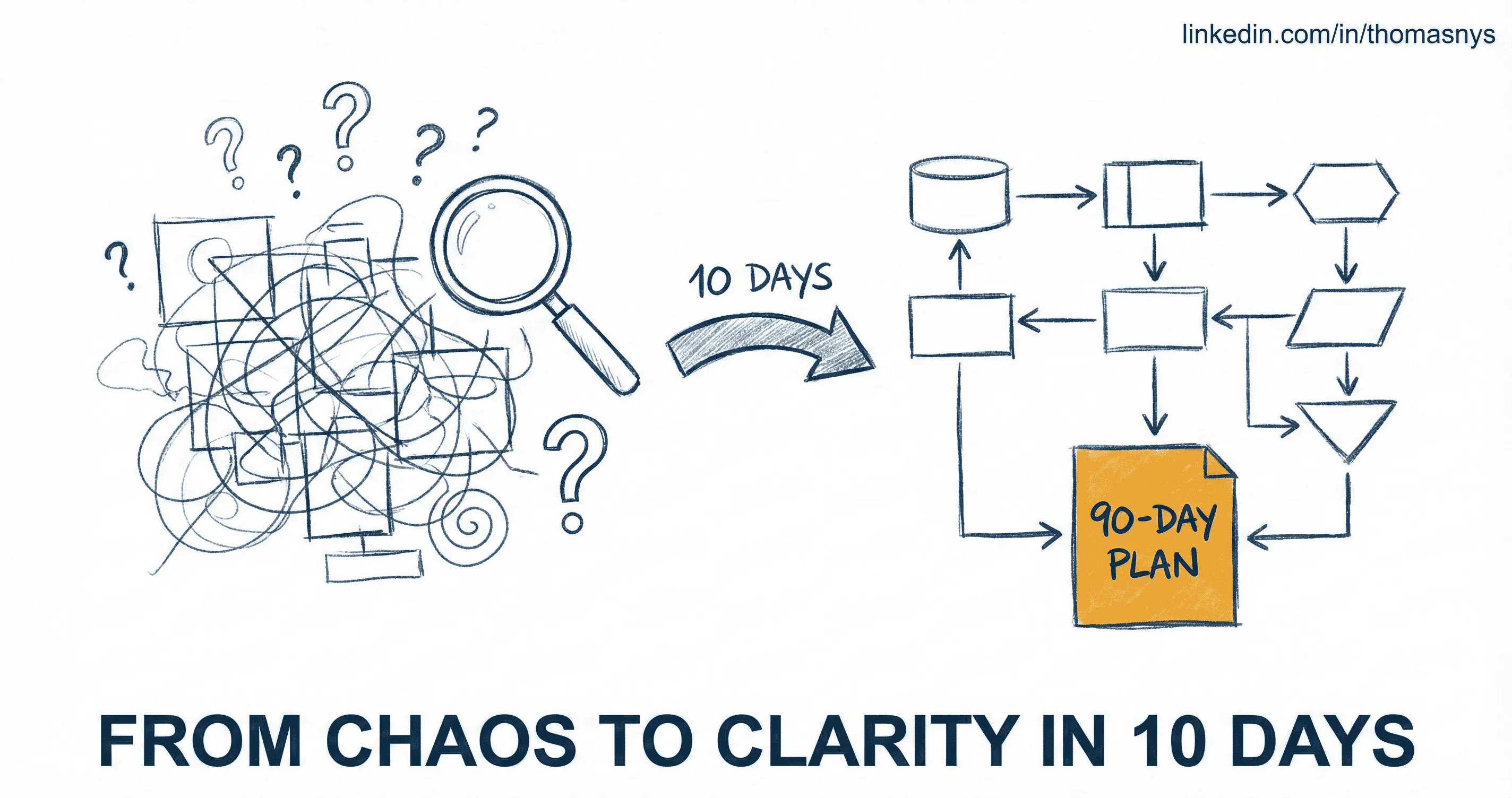
A comprehensive data architecture review that shows you exactly what’s broken, what’s costing you money, and what to fix first.
Who This Is For
Companies that feel their data stack is fragile, slow, or too expensive - and want a structured outside assessment.
Common triggers:
- Pipelines break regularly and nobody fully understands why
- Cloud bills rising but team can’t pinpoint what’s driving cost
- Considering a major platform change and want validation first
- New CTO/Head of Data wants unbiased view of what they inherited
- Preparing for due diligence - need to understand technical debt exposure
- Team keeps patching problems instead of fixing root causes
A data architecture review gives you clarity. Not vendor pitches. Not theoretical best practices.
A pragmatic data architecture assessment of where you are, what’s broken, and what to fix first.
What the Data Architecture Assessment Covers
This isn’t a checkbox audit. It’s a senior architect understanding your system end-to-end through a structured data architecture review.
Architecture & Data Flows
How data moves through your organization (data architecture fundamentals):
- Source systems → ingestion → transformation → storage → consumption
- Where are the bottlenecks?
- Where are single points of failure?
- Where does data quality degrade?
Technical Debt
Every platform accumulates shortcuts. The question isn’t whether you have debt - it’s whether you know where it lives.
I identify:
- Debt actively slowing your team
- Debt you can safely ignore
Cost Drivers
Cloud costs rarely come from one place.
I analyze compute, storage, data transfer, and licensing. Often 20% of workloads drive 80% of the bill - and many can be optimized without major rework.
Team Workflows
Architecture problems often trace back to people problems.
- Who owns what?
- Where do handoffs break?
- Where does work get stuck waiting?
Reliability & Observability
When something breaks (data lineage matters here):
- How quickly do you know?
- How quickly can you diagnose?
- How quickly can you fix it?
Governance & Data Quality
- Who decides what data means?
- How do you know if data is accurate?
- What quality checks exist?
- Who has access to what?
The 10-Day Structure
Fixed scope. Long enough to go deep. Short enough to deliver fast.
| Days | Phase | What Happens |
|---|---|---|
| 1-3 | Discovery | Review docs, access systems, stakeholder interviews |
| 4-6 | Analysis | Examine pipelines, query cost data, trace data flows |
| 7-8 | Synthesis | Connect technical findings to business impact, prioritize |
| 9-10 | Delivery | Present findings, walk through documentation, Q&A |
This isn’t handoff and disappear. I walk through everything so your team can act on it.
The Investment
A 10-day platform review costs a fraction of one bad architecture decision - or one quarter of unchecked cloud spend.
Compare to alternatives:
| Option | What It Costs | What You Get |
|---|---|---|
| Big 4 assessment | €50-100K+ | Generic frameworks, junior consultants |
| Internal audit | Weeks of senior time | Team too close to see problems |
| Platform review | 10 days of expert time | Specific findings, actionable plan |
The review typically identifies cost savings and risk reductions worth 5-10x the investment.
What You Get
1. Current-State Assessment
Documented view of your existing architecture:
- Architecture diagrams showing data flows
- Inventory of components, tools, dependencies
- Technical debt catalog with severity ratings
- Ownership map - who’s responsible for what
This becomes your baseline. The “before” picture.
2. Risk & Bottleneck Report
Prioritized list of reliability, scalability, and cost issues.
For each issue:
- What the problem is
- Why it matters (business impact)
- How urgent it is
- What fixing it requires
Not everything that could be better. The issues actually hurting you.
3. Target Architecture
Pragmatic future-state design addressing the biggest gaps.
Not a fantasy requiring total rebuild. A realistic evolution accounting for:
- Team skills and capacity
- Budget constraints
- Migration complexity
- Business priorities
4. 90-Day Action Plan
Sequenced plan for the next three months:
- What to fix now
- What to postpone
- What to ignore
Each item includes scope, success criteria, dependencies, effort estimate, and owner.
Designed so your team executes without ongoing external help.
What Changes After
- Clarity on where to focus - Know exactly which problems to tackle first
- Shared understanding - Tech and business see the same picture
- Confidence for big decisions - Decide on migrations or tool changes with data, not guesses
- Executable backlog - Practical improvements your team can actually ship
When This Makes Sense
| Situation | Why Review Helps |
|---|---|
| Before major investment | Invest in the right things |
| After leadership change | New CTO gets unbiased view of inherited systems |
| Symptoms clear, causes aren’t | Connect pipeline failures and cost spikes to root causes |
| Before due diligence | Know what investors will find before they do |
| Team stuck firefighting | Identify what’s causing the churn |
What This Is Not
After the Review
The review gives you clarity and a plan. What happens next depends on your team’s capacity.
Option 1: Your team executes
The 90-day action plan is designed so your team can implement without ongoing help. Most clients take this path.
Option 2: Advisory support
For complex decisions or when you want a sounding board during implementation → Architecture Advisory
Option 3: Fractional engagement
If you need ongoing architecture leadership to guide execution → Fractional Data Architect
No pressure either way. The review stands alone.
Related Thinking
- Red Flags: Symptoms of Poor Architecture
- Why Your Lakehouse Became a Swamp
- The Data Platform ROI Nobody Calculates
- Technical Debt Compounds Faster Than You Think
Related Services
- Architecture Advisory - Quick consult on specific decisions
- Fractional Data Architect - Ongoing architecture leadership
- Team Alignment Sprint - When team friction is the issue
Frequently Asked Questions
Frequently Asked Questions
What access do you need for the review?
How much of our team's time does this require?
What if we already know what's wrong?
Ready to scope your platform review?
Book a 30-minute call to discuss what a review would cover for your situation.