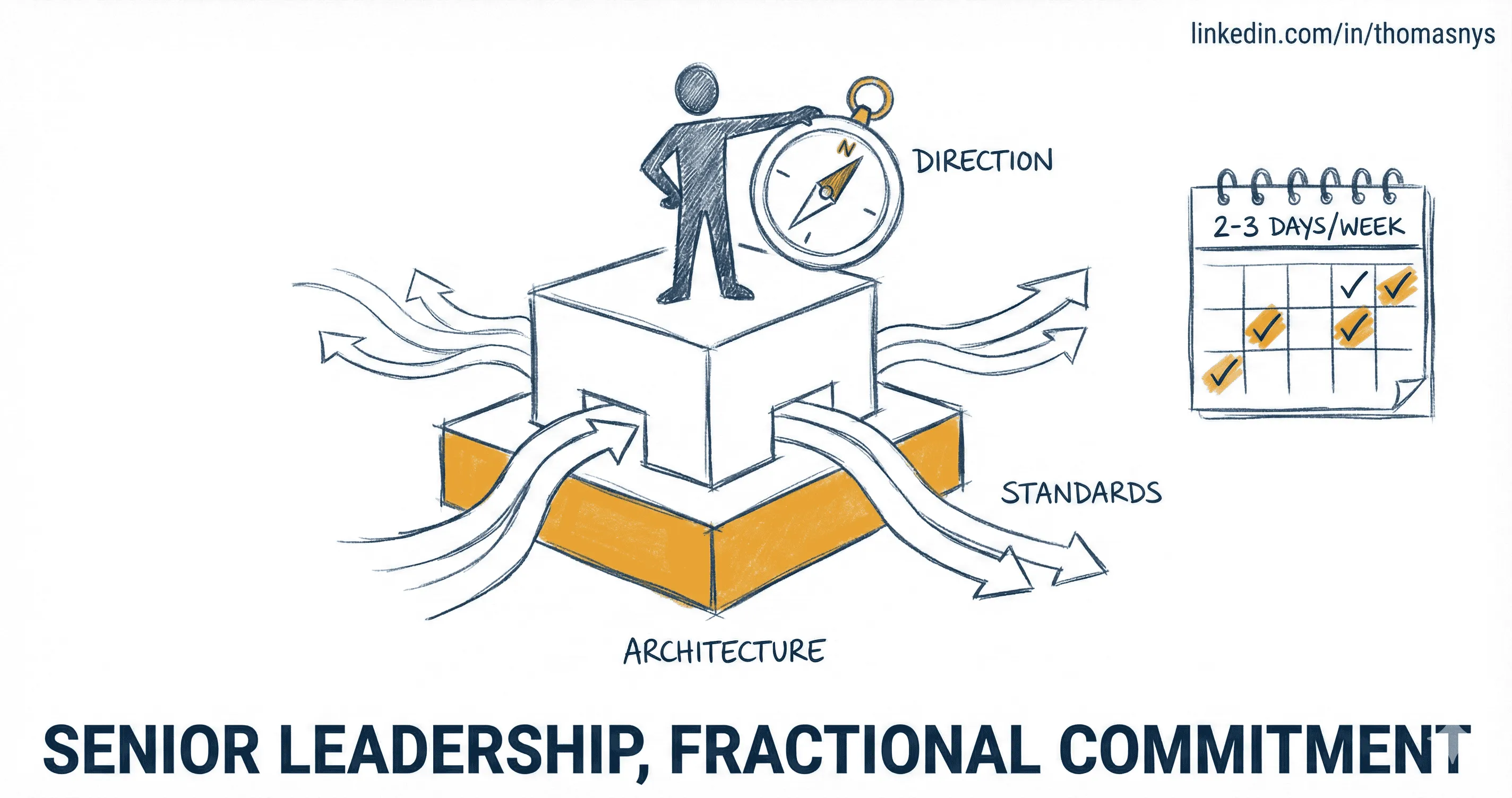
Senior data architecture leadership, 2-3 days per week. No full-time hire, no long recruiting process.
Who This Is For
Scaleups that need a senior data architect but aren’t ready for a full-time Head of Data. A data architect consultant on a fractional basis gives you the expertise without the overhead.
You might recognize these situations:
- Platform “works” but breaks at the worst times
- Cloud costs climbing and nobody can explain why
- Every new feature touches fifteen pipelines
- Senior engineers firefighting instead of building
- Technical debt compounding faster than features ship
- Stakeholders don’t trust the dashboard numbers
These aren’t signs of a bad team. They’re signs you’ve outgrown your current architecture.
The fix isn’t another mid-level hire who inherits the same problems. It’s senior leadership who sees the whole system.
What I Actually Do
Most teams confuse data engineering with data architecture.
Data engineers solve problems. Data architects decide which problems are worth solving.
Strategic Direction
I guide platform decisions across:
- Storage and data modeling
- Transformation and orchestration
- Observability and monitoring (data lineage, data quality)
- Governance and access control
But I don’t hand down edicts. I sit with your engineers, understand constraints, and make the “why” clear.
Hands-On Pairing
Architecture only matters if it ships.
I pair with engineers on implementation - reviewing PRs, debugging production issues, making sure patterns translate from whiteboard to code.
Knowledge Transfer
Every engagement should end with your team stronger.
I document decisions, create standards, and run working sessions. The knowledge stays with you - not with me.
Cross-Team Alignment
Data platforms sit between product, engineering, and operations.
I help these teams align on priorities, ownership, and ways of working.
How It Works
| Aspect | Details |
|---|---|
| Time | 2-3 days per week |
| Duration | 6-12 months |
| Location | Belgium (hybrid), Europe (remote + travel), Global (remote) |
Why 6-12 months? Architecture changes don’t show results in weeks. Meaningful platform shifts need two quarters to demonstrate stability and cost improvements.
The First 90 Days
Month 1: Discovery
- Map current architecture
- Interview stakeholders
- Identify highest-impact problems
Output: Clear picture of where technical debt lives and what’s driving cost.
Month 2: Quick Wins + Roadmap
- Address immediate pain points
- Build 6-12 month roadmap
- Prioritize by business impact, not technical elegance
Output: Credibility from quick wins + direction for deeper work.
Month 3: Implementation
- Ship meaningful improvements
- Establish patterns and standards
- Create architecture decision records
Output: Working code + documentation your team can maintain.
Deliverables
Architecture Decision Records (ADRs)
Documented decisions with context and rationale. When someone asks “why did we build it this way?” - the answer is written down.
Technical Roadmap
Prioritized 6-12 month plan. Not a wish list - a sequence accounting for dependencies, capacity, and business priorities.
Standards and Patterns
Guidelines for modeling, testing, deployment, observability. Reduces cognitive load. Prevents reinventing wheels.
Regular Architecture Reviews
Ongoing feedback on implementation. Catch problems early before they’re expensive.
What Changes
Companies I’ve worked with typically see:
- Fewer outages - Intentional decisions mean fewer mystery failures
- Platform enables instead of blocks - New use cases don't require rebuilding foundations
- Faster decisions - Trade-offs documented, debates don't repeat
- Team independence - Your team maintains and evolves without external help
Why Fractional?
For growing companies, full-time Head of Data often isn’t the right move yet.
Cost - Senior architects cost €150-250K+. Fractional = 30-50% of that.
Flexibility - Scale up during critical periods, down when stable.
Pattern recognition - I see the same problems across industries. Cross-pollination accelerates solutions.
No overhead - No recruiting, onboarding, or management chain to build.
Signs You Need This
- Data team grown past 3-4 people but lacks senior direction
- Preparing for funding round - need to demonstrate data maturity
- Cloud costs crossed urgent threshold
- Lost a key architect and need to fill the gap fast
- Teams building in silos, nobody owns the big picture
- Started AI initiative, realized data foundation isn’t ready
What Does a Data Architect Do?
A data architect designs how data flows through your organization. Not just the technical plumbing - the decisions about what gets captured, where it lives, who owns it, and how different systems talk to each other.
Data architect roles and responsibilities include:
- System design - Deciding which platforms, tools, and patterns to use
- Standards and governance - Setting patterns so teams don’t reinvent the wheel
- Trade-off decisions - Making cost, complexity, and capability trade-offs visible
- Technical leadership - Reviewing designs, mentoring engineers, and protecting long-term health
- Cross-team alignment - Translating between business needs and technical implementation
The difference between data engineering and data architecture: engineers build the bricks, architects own the blueprint. Both matter - but without architecture, engineering becomes reactive. See What Is a Data Architect? for the full breakdown.
Fractional vs Full-Time: Cost Comparison
For a deeper breakdown, see Fractional vs Full-Time Data Architect: Which Do You Need?
| Option | Annual Cost | What You Get |
|---|---|---|
| Full-time senior data architect | €150-250K+ | Dedicated resource, 100% availability |
| Fractional data architect (2-3 days/week) | 30-50% of full-time | Senior expertise, shared across clients |
| No architect | €0 direct | Technical debt accumulating invisibly |
The hidden cost of no architect shows up in:
- Cloud bills 2-3x higher than necessary
- Engineers rebuilding the same integrations repeatedly
- Platform migrations that take twice as long
- Technical debt that compounds quarterly
Fractional makes sense when you need senior direction but can’t justify - or can’t find - a full-time hire.
Related Thinking
- Why More Developers Won’t Fix Delivery Problems
- The Genius Developer Anti-Pattern
- How Poor Architecture Turns Seniors Into Firefighters
- 40% Maintaining, 20% Innovating
- Data Architecture vs Data Engineering - Understanding the difference
Related Services
- Platform Review - Start with a 10-day assessment
- Architecture Advisory - Lighter-touch guidance for specific decisions
- Data Architect Consultant - Learn about consulting engagements and when to hire
- Hiring & Team Support - Build out your data team
Frequently Asked Questions
Frequently Asked Questions
How quickly can a fractional data architect start?
What if we need more than 2-3 days per week?
How do you work with our existing team?
Ready to discuss fractional data architecture?
Book a 30-minute call to explore whether fractional architecture leadership fits your situation.