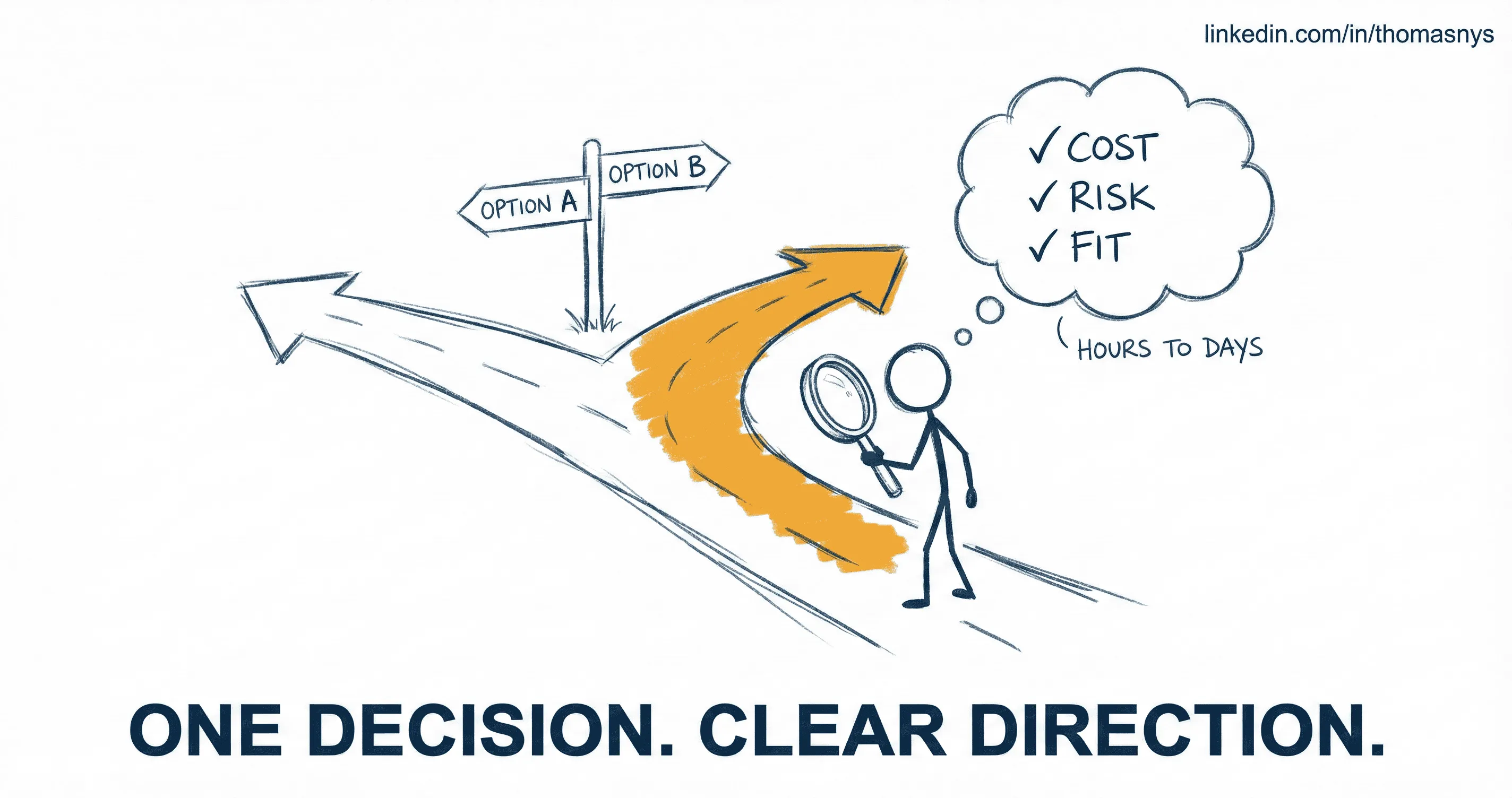
Expert answers to specific architecture questions. A data architecture consultancy service with fast turnaround and no ongoing commitment required.
Who This Is For
Teams facing a specific architecture question who want senior data architecture consultant input before committing.
Common triggers:
- Evaluating a major tool change (Snowflake vs Databricks vs BigQuery)
- Validating a migration approach before starting
- Cloud costs spiked - need to find optimization opportunities
- Your team proposed an architecture and you want a second opinion
- Internal debates are stuck - need an outside perspective
- AI initiative starting - need to assess data readiness
Data architecture advisory isn’t ongoing engagement. It’s getting the right answer to a specific question, fast. Whether you need a modern data architecture consultant for a one-time decision or extended guidance during a critical period, advisory scales to fit. See What Is Data Architecture? for foundational concepts.
The Three Questions I Ask First
1. What problem are you actually trying to solve?
Technology decisions should trace back to business problems. If we can’t articulate the problem, we’re not ready to discuss solutions.
2. What happens if you do nothing?
Sometimes the current state is fine for now. Understanding inaction cost calibrates how much effort the solution should involve.
3. What constraints are non-negotiable?
Budget, timeline, team skills, existing contracts. Knowing constraints upfront prevents recommending solutions that can’t be implemented.
What Advisory Looks Like
You bring a question. I bring experience from similar decisions across dozens of companies.
Decision Framing
Most architecture debates get stuck because the question is wrong.
❌ “Should we use Snowflake?”
✅ “Given our query patterns, team skills, and budget - what warehouse serves us best for the next three years?”
Sometimes the answer isn’t a technology choice. It’s a process change or organizational clarification.
Trade-off Analysis
Every architecture decision involves trade-offs. My job is making them explicit.
For tool selections:
- Cost at your scale
- Learning curve for your team
- Integration with existing stack
- Vendor lock-in risks
- Capability gaps
For migrations:
- What needs to change vs what can stay
- Risks at each stage
- Realistic effort estimates
Documented Recommendations
You get a written recommendation - not just verbal advice.
When someone asks “why did we choose this?” in a year, the answer is written down.
Engagement Options
Quick Consult (2-4 hours)
Sanity check or second opinion on straightforward questions.
- “Is our proposed dbt project structure reasonable?”
- “Should we add a semantic layer now or wait?”
- “What are the red flags in this vendor proposal?”
Output: Verbal recommendation + brief written summary
Deep Dive (1-3 days)
Complex decisions requiring analysis of your specific context.
- “Which data warehouse should we migrate to?”
- “How should we restructure pipelines to reduce costs?”
- “What’s the right approach for real-time given our use cases?”
Output: Comprehensive written recommendation + architecture diagram
Extended Advisory (1-2 days/week, 1-3 months)
Ongoing guidance during a critical period.
- Platform migration needing architectural oversight
- New data product wanting continuous review
- Team making many technical decisions needing a sounding board
Output: Regular input on decisions + documentation of key choices
Common Topics
Tool Selection
Which warehouse? Which orchestrator? Which transformation tool?
These decisions lock you in for years. I help evaluate based on your actual needs - not vendor marketing.
I’ve worked across Snowflake, Databricks, BigQuery, Redshift, and Azure Synapse. Real production experience, not just documentation. See Snowflake vs BigQuery vs Databricks: How to Actually Choose for my independent comparison.
Migration Planning
Migrations go smoothly or turn into multi-year nightmares. The difference is planning.
What I cover:
- Scope - what actually needs to move?
- Risks - where will things break?
- Sequencing - what order minimizes disruption?
- Validation - how do you test before cutover?
- Rollback - what if things go wrong?
Cost Optimization
Cloud costs creep up. By the time they’re a problem, they’re often 2-3x what they should be.
Common findings:
- Compute running 24/7 that could be scheduled
- Hot storage that should be cold
- Queries scanning full tables instead of partitions
- Redundant pipelines processing the same data
- Reserved capacity mismatched to usage
Real-Time vs Batch
“We need real-time” is one of the most expensive sentences in data engineering.
Often, near-real-time or batch would serve the business at a fraction of the cost. Advisory helps figure out what you actually need.
AI Readiness
Everyone wants AI. Few have the data foundation to support it.
I assess whether your platform is ready for ML workloads - and what gaps to address first.
Data Architecture Review
A comprehensive data architecture review examines your current data systems against best practices and your business requirements. It answers: “Is our architecture working? Where are the gaps?”
A typical architecture review covers:
- Current state documentation - How data flows today, what systems exist, where data lives
- Pain point identification - What’s slow, broken, or causing friction
- Gap analysis - What’s missing compared to where you need to be
- Risk assessment - Security, compliance, reliability, and scalability concerns
- Recommendations - Prioritized improvements with effort estimates
- Roadmap - Sequenced plan for addressing gaps
Architecture reviews are particularly valuable when:
- Preparing for a major platform change
- Inheriting a system from a previous team
- Cloud costs are rising without clear cause
- Teams are blocked by data infrastructure limitations
- Compliance requirements are increasing
A review typically takes 3-5 days depending on complexity, resulting in a written assessment with clear recommendations.
What You Get
Written Recommendation
Not a generic best-practices document. A specific recommendation for your specific situation:
- Summary of question and context
- Options considered
- Trade-offs for each option
- Recommended approach with reasoning
- Key risks and mitigations
- Next steps
Architecture Diagram (where applicable)
A technical diagram engineers can reference - not a marketing slide.
Risk Assessment
Key risks for your chosen approach with suggested mitigations. You go in with eyes open.
What Advisory Is Not
For ongoing architecture ownership → Fractional Data Architect
For implementation help → We can discuss follow-on work
Related Thinking
- The 100K Cloud Migration Mistake
- The False Economy of Skipping Architecture Reviews
- Architecture Advisory: The 3 Questions I Ask First
- AI Won’t Fix Your Architecture
Frequently Asked Questions
Frequently Asked Questions
How much does a data architect cost?
What does data architecture advisory include?
When do you need a data architecture consultant?
Related Services
- Platform Review - Structured 10-day assessment
- Fractional Data Architect - Ongoing architecture leadership
Have a specific architecture question?
Book a 30-minute call to discuss what you’re trying to decide.