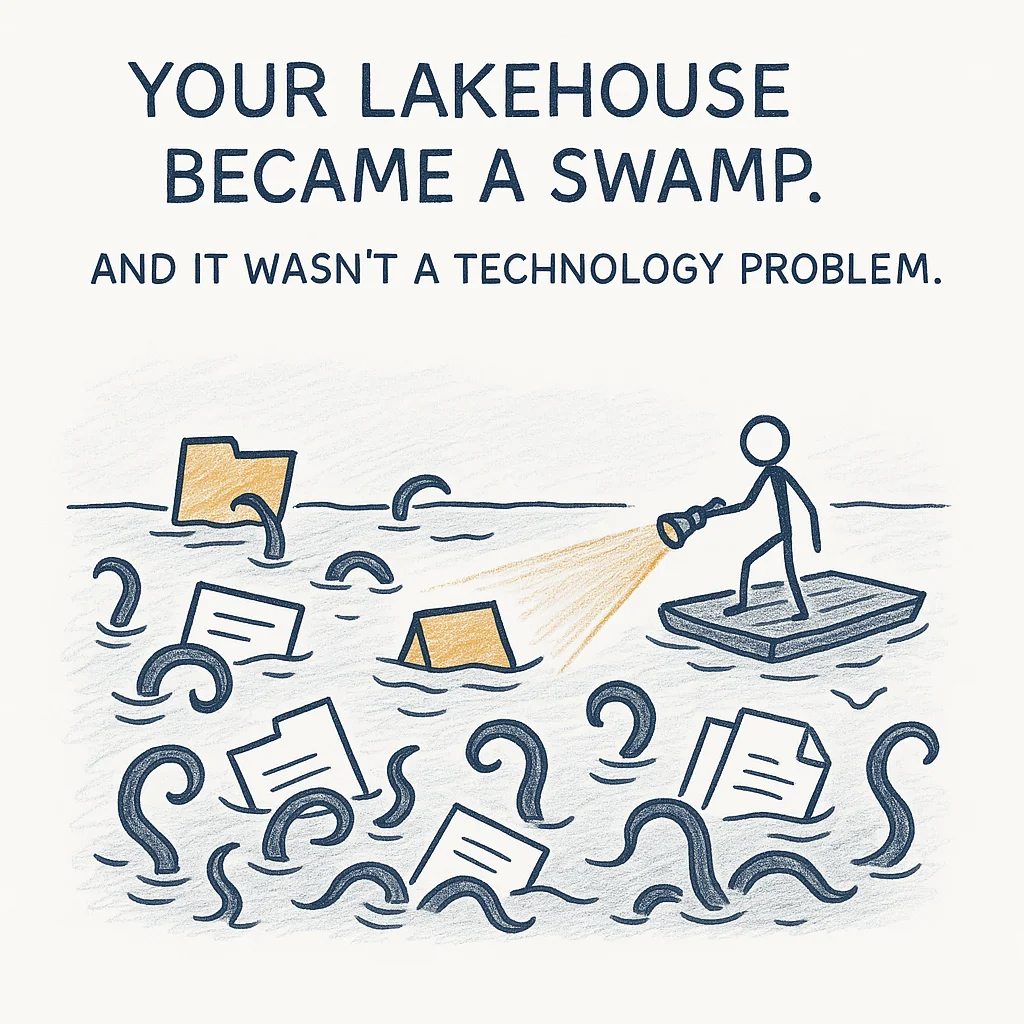
Your lakehouse became a swamp. And it wasn’t a technology problem.
The pitch was compelling: unified analytics and AI on one platform. Best of data lakes and warehouses. Schema enforcement when you need it, flexibility when you don’t.
Three years later:
Nobody knows what’s in there. Datasets have cryptic names and no documentation. The same data exists in 14 versions, none marked as authoritative. Analysts spend more time hunting for data than analyzing it. And when they find it, they don’t trust it.
The swamp didn’t happen because you picked the wrong technology. It happened because of three organizational failures:
No ownership. Data landed without anyone responsible for quality, meaning, or lifecycle.
No contracts. Producers changed schemas without telling consumers. Breaking changes discovered in production.
No curation. Raw data treated as finished product.
These governance and design failures all trace back to weak data architecture. A lakehouse is infrastructure. It doesn’t create value-it enables it. But enablement without governance creates chaos at scale. And you can’t layer AI on a swamp and expect clarity.
The fix isn’t a better platform. It’s clear ownership, explicit contracts between producers and consumers, and treating data as a product that requires ongoing investment. A platform review can help you understand where your lakehouse went wrong and what to fix first.
Has your lakehouse become a swamp?