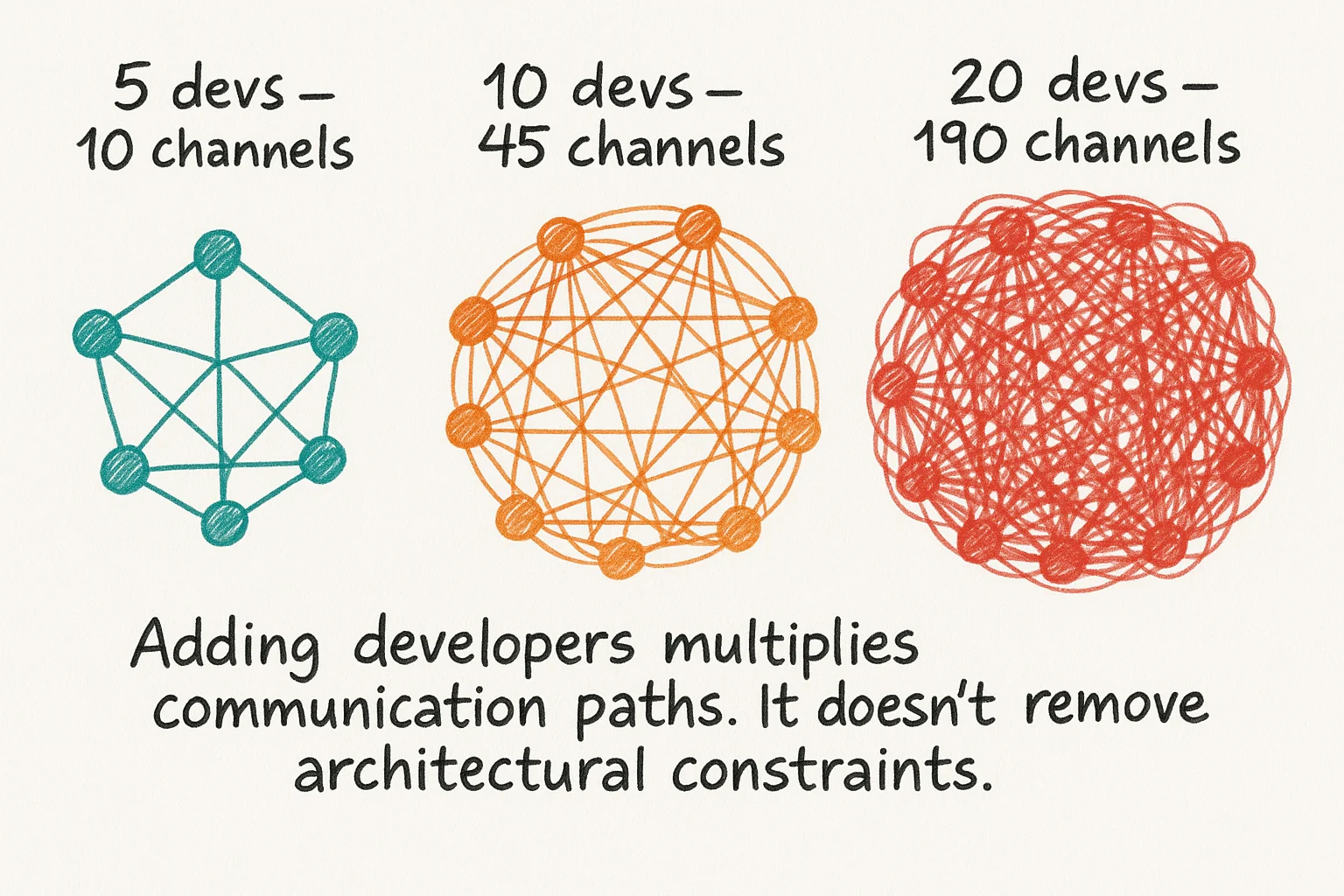
You hired ten more developers. Delivery got slower. That’s not a paradox, it’s physics.
Brooks’s Law is 50 years old. We still ignore it.
On paper, more people should mean more output. In reality, this is what happens:
Communication paths multiply. Ten developers means 45 communication channels. Twenty means 190. Each channel is a potential delay, misunderstanding, or dependency.
Onboarding absorbs capacity. Teaching is essential, but it pulls your most experienced people away from delivery.
Coordination overhead explodes. More people mean more meetings, more alignment, and more waiting for decisions.
The constraint was never capacity. It was architecture.
If your system can’t be worked on independently by small teams, adding people adds friction, not velocity. If every change requires coordinating across multiple teams, more teams mean more coordination, not more output.
The solution isn’t headcount. Its boundaries. Clear ownership. Decoupled systems that let teams move independently. That means clear service ownership, APIs that don’t require cross-team negotiation for every change, and deployment pipelines that don’t bottleneck on a central group.
Fix the architecture, then scale the team.
Before you open the next requisition, ask yourself: What would you need to change in your system design before adding more developers would actually help?