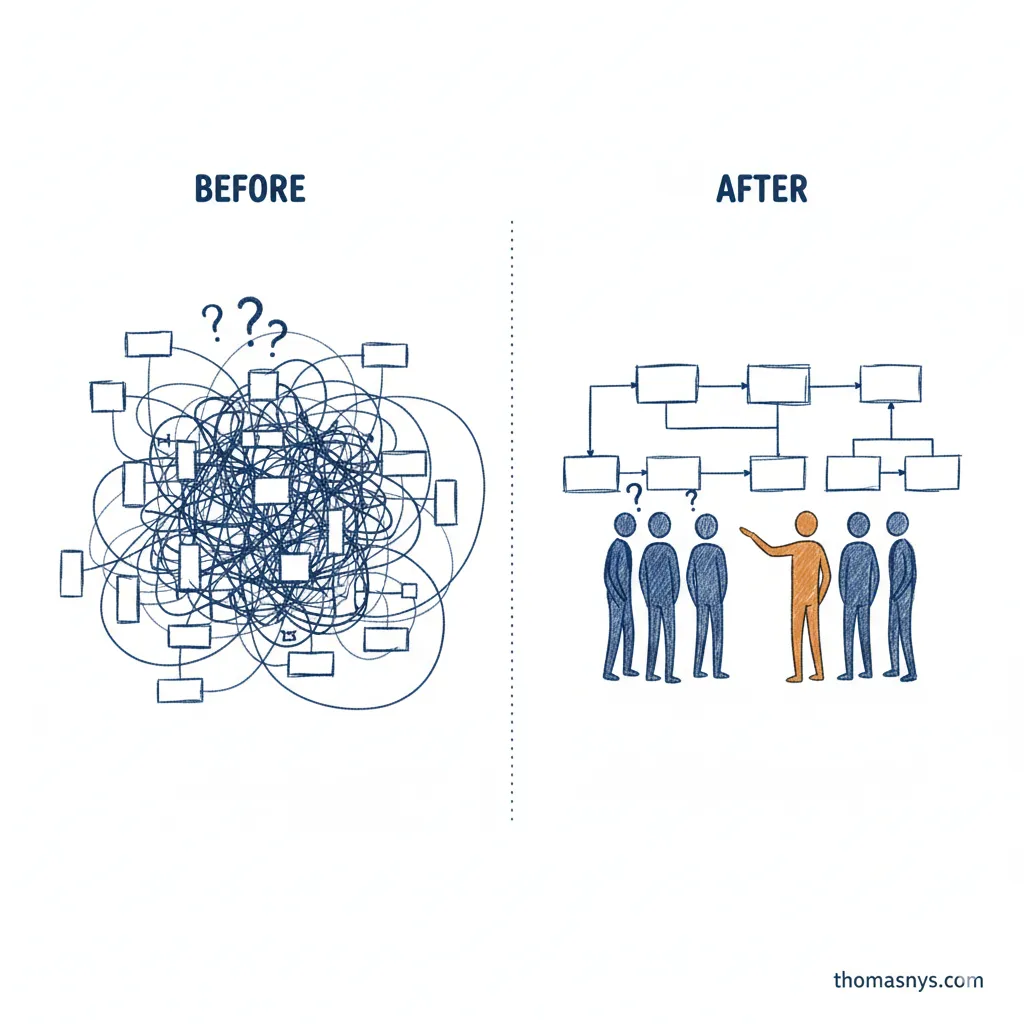
Most companies hire a data architect consultant reactively. Something breaks. Costs spike. A migration stalls. Then someone says “we need outside help.”
That’s fine. But the timing of the hire shapes whether it actually fixes things or just produces a nice report that collects dust. I’ve been on both sides of that - the engagements that changed everything and the ones where I was brought in too late or for the wrong reasons.
Here’s how to think about it.
Three Reasons Companies Hire a Data Architect Consultant
1. The Platform Outgrew the Team
This is the most common one. Your data team built the platform when the company was 20 people. Now you’re 80. The pipelines that worked fine at startup scale are breaking under load. Schema changes take days instead of hours. Everyone’s firefighting.
Your engineers are competent. That’s not the issue. The issue is they’re optimizing locally - fixing individual pipelines - when the problem is structural. A data architect consultant zooms out to the system level. They see patterns across companies that your team, inside one company, can’t see.
I typically see this at the Series A to Series B transition. The team goes from “build fast” to “build to last” and realizes the architecture wasn’t designed for the second phase.
2. You Need an Unbiased Outside Perspective
Internal teams have context. That’s their strength. But they also have history, politics, and sunk cost bias. The person who built the current platform has emotional investment in it. The team that chose Snowflake doesn’t want to hear they should’ve picked BigQuery.
A data architect consultant doesn’t carry that baggage. They can say “this design choice is costing you EUR15K/month” without worrying about who made it.
I got this wrong early in my career, by the way. I used to think the value was purely technical - better designs, cleaner architectures. Now I think the biggest value is the permission an outsider gives the team to question their own assumptions.
3. Senior Depth Without Full-Time Overhead
Not every company can justify a full-time data architect. If you’re a 30-person startup with a 3-person data team, you don’t need someone in that role 5 days a week. But you absolutely need senior architecture thinking for the decisions that’ll shape the next 2-3 years of your platform.
A data architect consultant fills that gap. 1-3 days a week, 3-12 months. You get the strategic thinking without the full-time cost. When the engagement ends, your team should be stronger - not dependent.
Consultant vs Full-Time: When Each Makes Sense
This is simpler than people think:
Hire a data architect consultant when:
- You have a specific problem to solve (platform review, migration, cost optimization)
- You need senior architecture expertise but can’t fill a full-time role
- You want an unbiased assessment of your current state
- You’re making a major platform decision and want experienced input
Hire full-time when:
- You have sustained, ongoing architecture work (not a one-time fix)
- You need deep business context more than broad pattern recognition
- You’re large enough that architecture decisions happen weekly
- You can attract and retain the right person (harder than it sounds)
The mistake I see most often: hiring a consultant when you actually need a full-time lead. If the problem is ongoing direction and daily decisions, a consultant who shows up 2 days a week won’t cut it. You need someone embedded.
The reverse mistake: hiring full-time when you need 3 months of focused expertise. Now you have an expensive hire solving a problem that’s already been solved, looking for work to justify the role.
Red Flags You’re Hiring the Wrong Person
Not all data architect consultants are equal. Some signs you’re talking to the wrong one:
They recommend tools before understanding your problems. If the first conversation is about Snowflake vs Databricks and nobody’s asked “what are you trying to solve?”, walk away. This is the strategy-tool confusion I see everywhere - and it’s the biggest landmine in the data space.
They work independently instead of with your team. A good consultant pairs with your engineers, transfers knowledge, builds capability. A bad one disappears for three weeks and comes back with a slide deck your team can’t execute.
They can’t explain tradeoffs clearly. Every architecture decision has costs. If someone presents a solution without naming what you’re giving up, they’re selling, not consulting.
They’ve never built what they’re designing. Pure strategists who haven’t gotten their hands dirty with actual pipelines, actual schema migrations, actual production incidents - they’ll design systems that look beautiful on paper and fall apart in practice. You want someone who’s both architect and engineer.
When You Shouldn’t Hire a Data Architect Consultant
Honest answer: not every company needs one.
Your platform is simple and working. If you have a straightforward setup - a few data sources, a warehouse, some dashboards - and it serves the business, don’t fix what isn’t broken. A consultant will find things to improve (we always do), but that doesn’t mean they’re worth improving right now.
You’re pre-product-market-fit. If you’re still figuring out your product, your data architecture should be the simplest thing that works. Investing in architecture at this stage is premature optimization. I know this from experience - I’ve built for scale that never came.
The problem is process, not architecture. If your data team is underwater because of unclear priorities, too many ad-hoc requests, or ownership vacuums, that’s a management problem. A new architecture won’t fix it. A team alignment sprint might.
You can’t act on recommendations. If the team has no capacity to implement changes, a review will produce a document that sits on a shelf. Fix the capacity problem first.
What to Expect From a Good Engagement
The best data architect consultant engagements follow a simple pattern:
- Discovery - Understand your business context, audit the current platform, interview stakeholders and engineers
- Design - Identify improvements, evaluate options, create a realistic target architecture
- Transfer - Hand off knowledge, document decisions, make your team capable of executing without ongoing help
The output isn’t a perfect architecture. It’s clarity - knowing what to build, what to fix, what to ignore, and in what order. That clarity is usually worth 10x the cost of the engagement.
Related Reading
- Data Architect Consultant: When to Hire & What They Do - Comprehensive guide to working with consultants
- What Is a Data Architect? - Role and responsibilities explained
- You’re Hiring Data Engineers Wrong - Common hiring mistakes in data teams
- Architecture Advisory: The 3 Questions I Ask First - What the first week looks like
Not sure if you need a consultant? Book a 30-minute call to talk through your situation. No pitch - just an honest assessment of whether it makes sense.