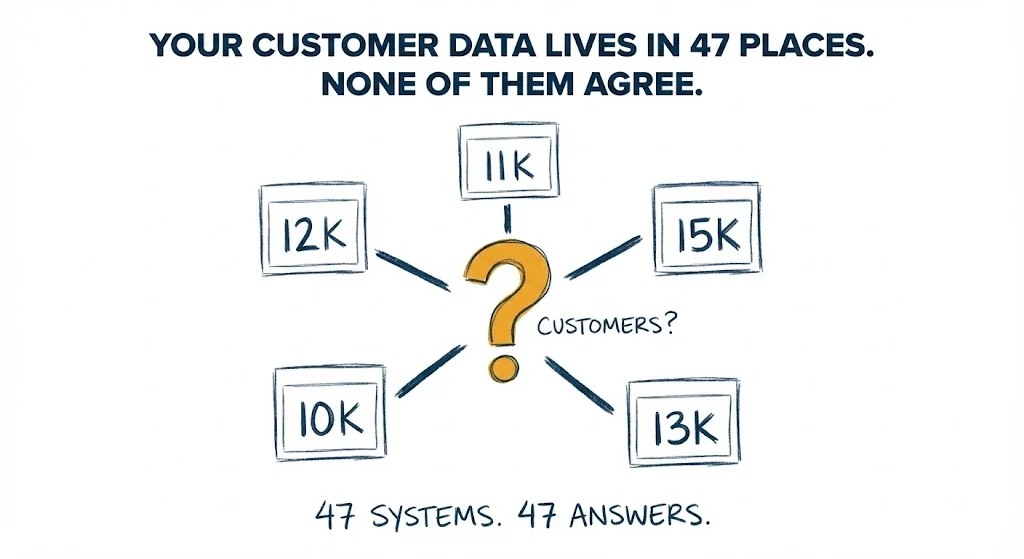
Your customer data lives in 47 places. None of them agree.
CRM says 12,000 customers. Finance says 11,400. Marketing says 15,000. Support says 9,800. Everyone is right-by their own definition.
This isn’t a data quality problem. It’s a governance problem.
Each system was built for a purpose. Each defined “customer” based on that purpose. Is a trial user a customer? Depends who you ask. Prospect versus paying. Active versus churned. Account versus contact. Nobody wrote down the definitions. Nobody assigned ownership. The systems multiplied.
The cost shows up monthly. Analysts spend days reconciling spreadsheets. Board reports contradict last month’s numbers. Compliance can’t prove how many people’s data you hold.
The instinct is to centralize. Build a data warehouse. Implement MDM. Create a single source of truth. But centralization without governance just moves the problem. You get one more system with one more definition that nobody agreed on.
Governance isn’t about where data lives. It’s about who owns the definition, who enforces it, and what happens when systems diverge. The foundation for proper governance is solid data architecture - which defines who owns what, what standards apply, and how data flows across systems. Customer data can live in 47 places - as long as those 47 places agree on what “customer” means.
The fix isn’t consolidation. It’s accountability. One owner for the definition. Clear rules for how each system inherits or extends it. Regular reconciliation with consequences.
Data doesn’t need to be centralized. It needs to be governed.
Who owns the definition of “customer” in your organization?