Westrum Culture In Data Teams
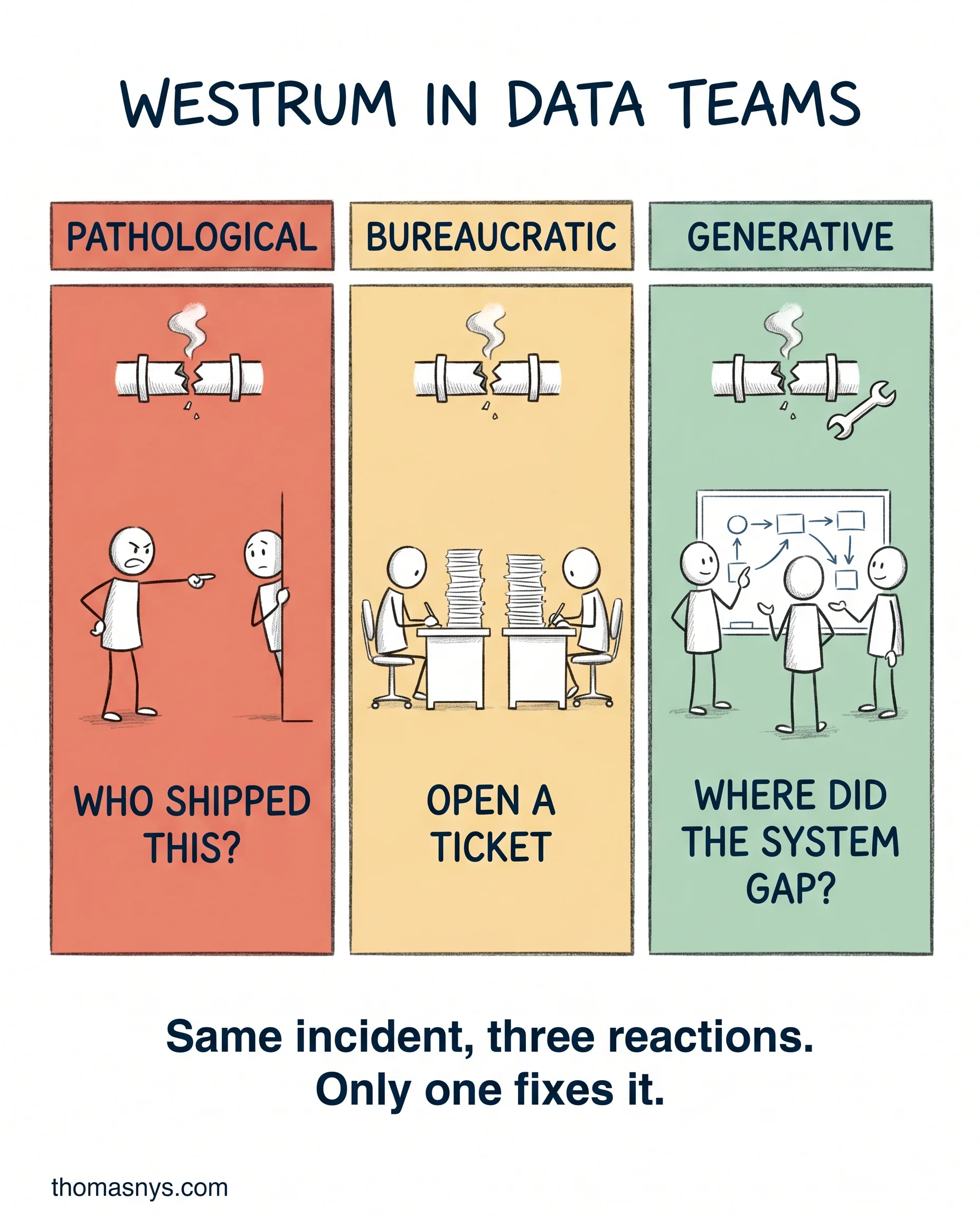
If your post-mortems start with “who shipped that,” your org culture is the bug.
Ron Westrum’s culture typology (pulled into DORA research a decade ago) splits orgs into three types: pathological, bureaucratic, generative. The pattern shows up clearly in how data teams respond to failure.
Pathological teams hide problems. Pipeline broke? Find the engineer who shipped it. Punish them quietly. Nobody volunteers information again. The same bug recurs, untraced.
Bureaucratic teams document everything. Pipeline broke? Open a ticket, fill in the template, follow the process. The incident gets recorded but the underlying fix never ships because everyone’s optimizing for the paperwork instead of the system.
Generative teams treat failures as system signals. Pipeline broke? Inquiry begins immediately. Where did the assumption fail? What gap let the bad change reach prod? Action items address the gap, not the engineer.
The diagnostic question I ask new clients: when something breaks, what’s the first conversation? If it’s “who did this,” you’re closer to pathological than you think.
Most teams believe they’re generative. They’ve read the books. They run blameless post-mortems on paper. The social signals tell a different story: eye-rolling in meetings, certain engineers getting fewer reviews, sidebar Slack conversations about “the people who can’t ship clean code.”
You can change this. It takes about 18 months of consistent behavior from leadership, starting with stopping the “who shipped it” question publicly. After that, failures get reported the same day they happen.
After your last data incident, what was the first question in the room?
Fractional Data Architect helping startups and scaleups build data platforms that scale.
More about Thomas Nys →