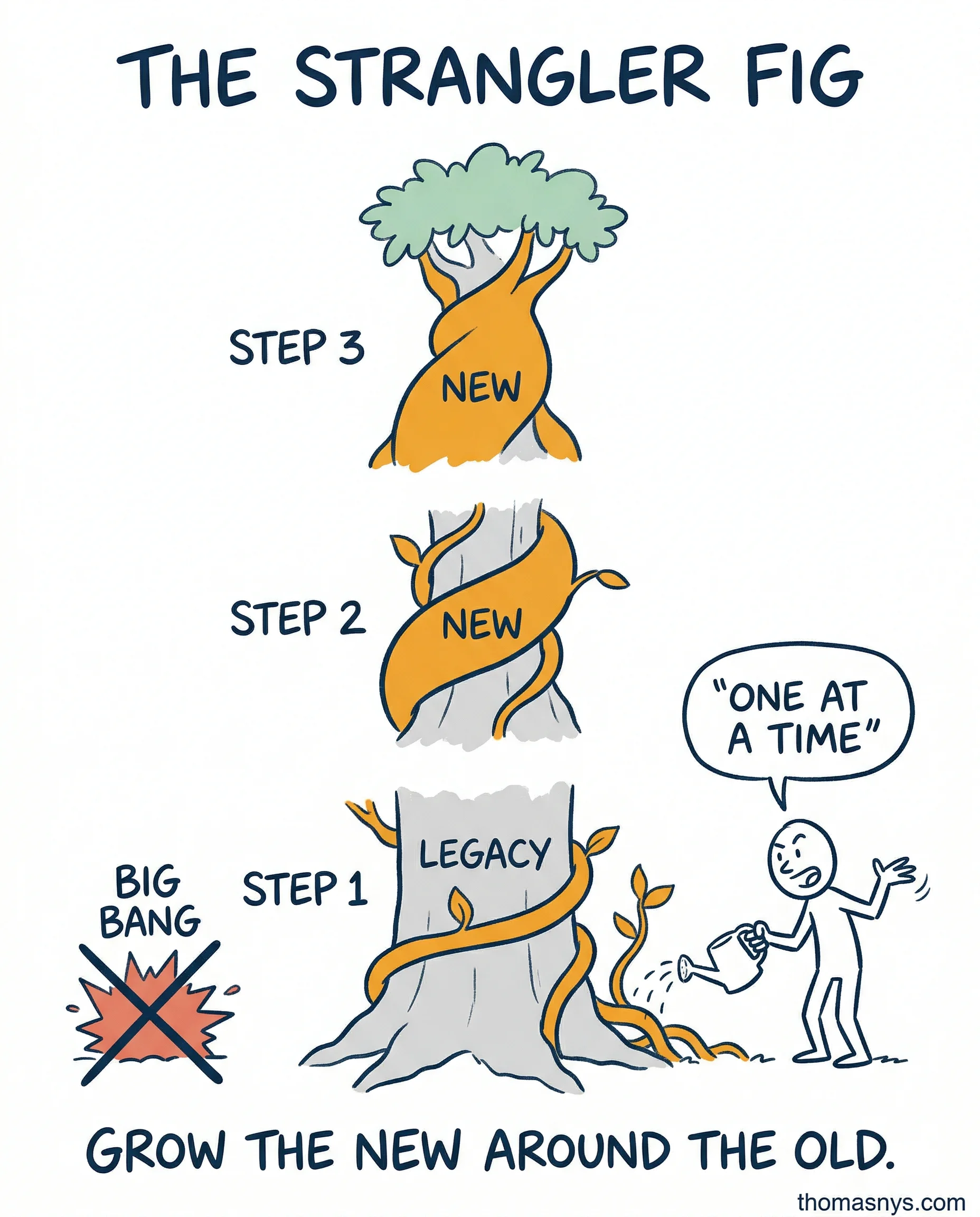
You don’t migrate a data platform in one go. You grow the new one around the old one.
I’ve watched teams plan 6-month “big bang” migrations that turn into 18-month nightmares. Everything has to move at once. One delay cascades into twenty. Rollback plans exist on paper but not in reality.
The strangler fig pattern works differently. Like the tree it’s named after, the new system grows around the old one.
Step 1: Route all new data products to the new platform. Don’t touch legacy yet.
Step 2: Migrate the highest-value, lowest-risk existing products. Pick the ones with clear ownership and good test coverage.
Step 3: Leave legacy for read-only access. Sunset it gradually as consumers move over.
This takes longer on paper. In practice, it often finishes sooner because you’re not blocked by the one team that can’t migrate until Q4.
The real win is learning. Each migration batch teaches you something about the next one. Big bang doesn’t give you that feedback loop.
What’s your rollback plan if it doesn’t? That’s usually where the conversation gets quiet.
Are you planning a migration? What’s your rollback plan?