The Day Our Pipeline Became a Person's Full-Time Job
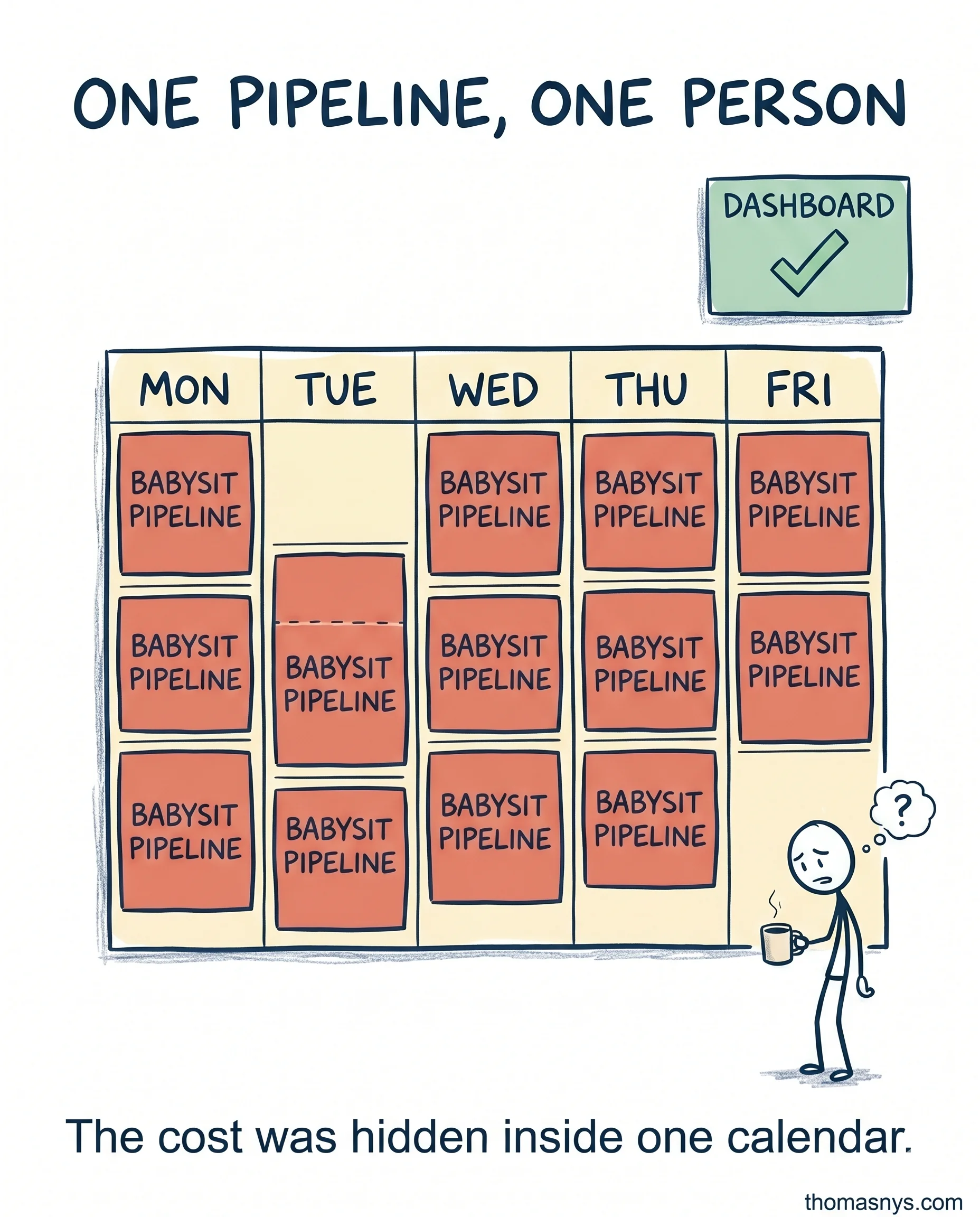
The day I realized our pipeline had become a person’s full-time job.
A few years back, walking through a client’s data team standup, I asked their senior engineer what he’d worked on that week. His honest answer: “babysitting the customer ingestion pipeline.”
Babysitting. Eight hours a day, five days a week.
Manual reruns when it failed at 3am. Hand-patching schema changes from upstream. Re-validating numbers when finance complained. The pipeline shipped two years earlier as a “temporary” solution. By now, it was a full-time job for a senior engineer making €90K+.
Nobody flagged it because the numbers kept landing. Stakeholders saw a green dashboard. Leadership saw a productive team. The cost was hidden inside one person’s calendar.
This is the failure mode of organic growth. You don’t notice when 10% of an engineer’s time becomes 30%, then 60%, then their entire week. There’s no alarm. There’s just a slow drift toward one person becoming the system.
Two things that surface this:
- An honest time audit. The question that works: “if you disappeared tomorrow, who’d run this?”
- A Brent test. Borrowed from The Phoenix Project. Find the engineer everyone routes around. That person is your bottleneck and your single point of failure.
The fix is making the cost visible, then funding the rebuild like the business priority it actually is. Don’t fire the engineer. Don’t rewrite overnight. We rebuilt that pipeline over the next quarter. Engineer got 30 hours a week back. Nobody had ever quantified what they were losing.
Who’s the person on your team whose calendar belongs to one system?
Fractional Data Architect helping startups and scaleups build data platforms that scale.
More about Thomas Nys →