The Data Product Canvas (One-Page Definition)
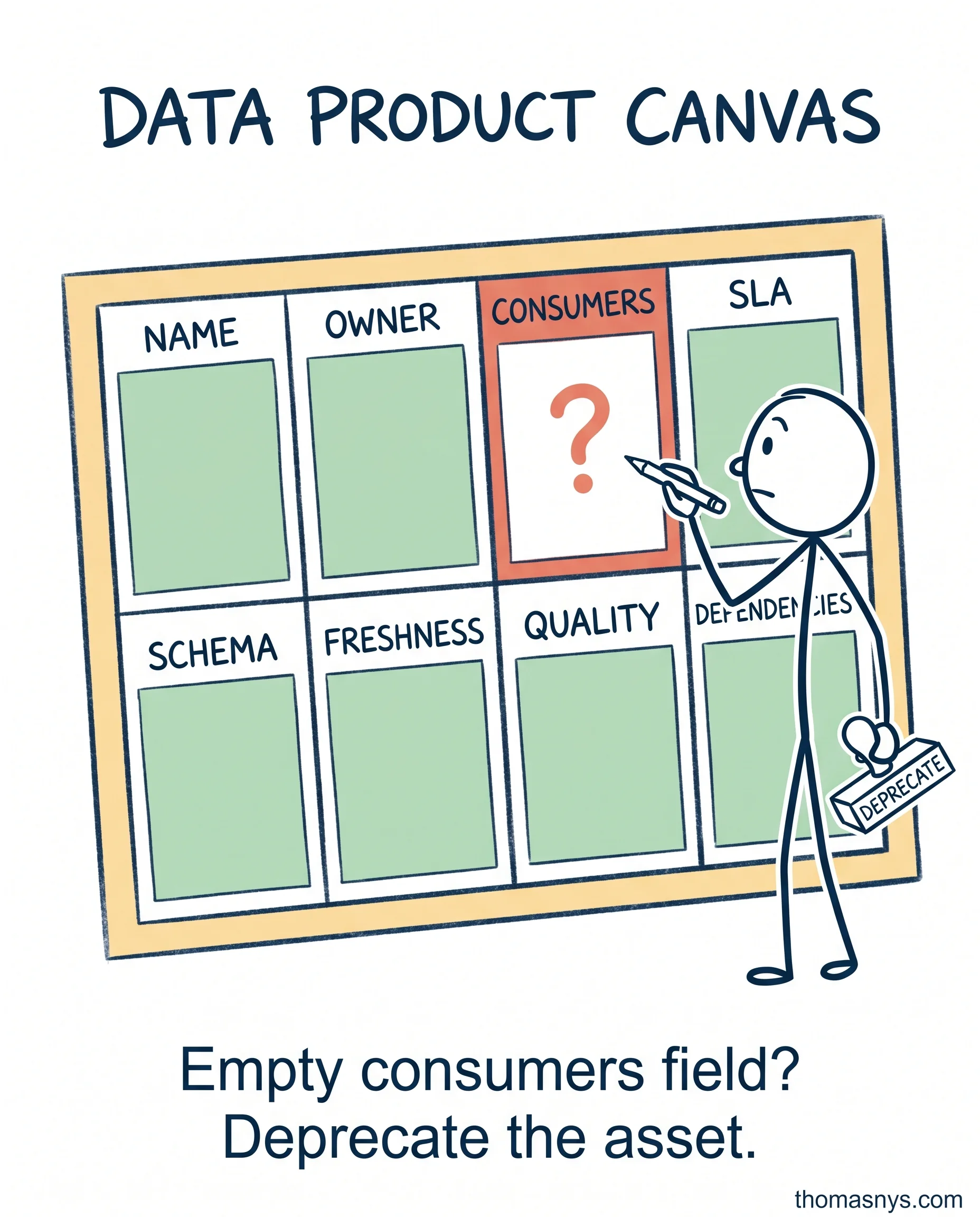
An empty “consumers” field is the signal to deprecate the asset. Most teams ignore it.
“Data product” became the term of art around 2022. Most teams adopted the language and skipped the discipline. They renamed their gold tables and called it a day. Now they have 30 of them and no idea which ones still matter.
Here’s the one-pager I run with clients. Eight fields. The “consumers” field does most of the work.
- Name. What is this thing called, consistently, across teams?
- Owner. One person, named. “The data team” is not an owner.
- Consumers. Who uses this and for what decision?
- SLA. How fresh, how available, how accurate? Numbers.
- Schema. Documented and versioned, with a contract for breaking changes.
- Freshness. Latency in hours or minutes. “Regularly” is not a number.
- Quality metrics. What does “good” look like? What triggers an incident?
- Dependencies. What upstream sources does this depend on?
When you fill in “consumers,” three things happen. The active products get clearer ownership and SLAs because someone’s actually using them. The questionable ones surface (“nobody since Q3”). The dead ones reveal themselves. That last category is the one nobody wants to find but everyone has.
I ran this exercise with a client last quarter. 47 “data products” listed in their catalog. After the canvas, 12 had real consumers, 9 were ambiguous, 26 had nobody. We deprecated 22 in the next sprint and freed up roughly 30% of pipeline cost.
A data product is a contract. The canvas is the place where the contract gets written down. And where the unsigned ones get cancelled.
Of your “data products,” how many would survive this test?
Fractional Data Architect helping startups and scaleups build data platforms that scale.
More about Thomas Nys →