Status Quo Is Never Free: Why Your 'Do Nothing' Option Has the Biggest Hidden Price
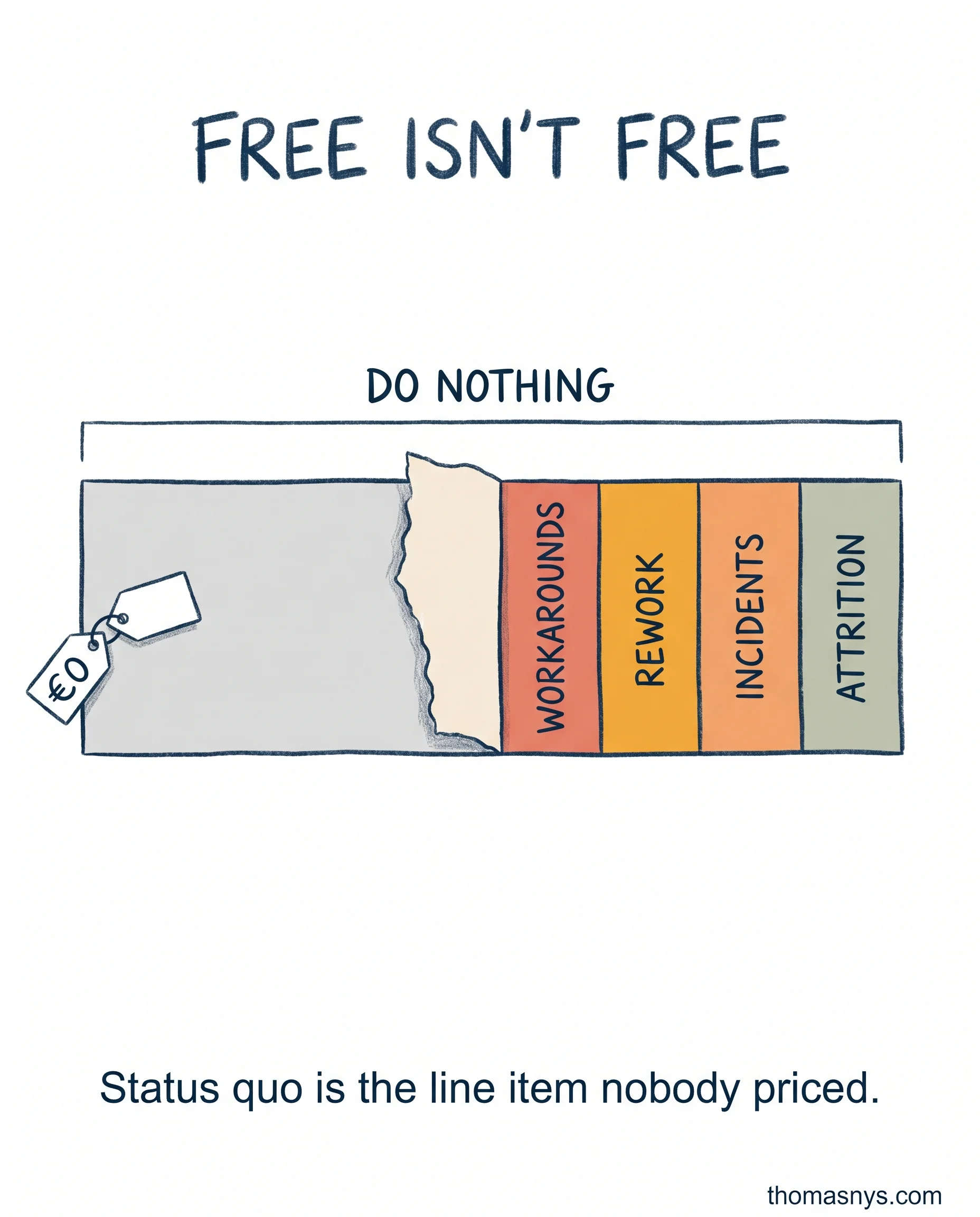
“Do nothing” is never free. One client’s “zero cost” status quo was burning 200K a year in workarounds nobody tracked.
Build-vs-buy debates always have a third option on the slide: “keep doing what we’re doing.” And it’s almost always priced at zero. That’s the bug in the model.
Status quo costs don’t show up as line items. They show up as senior engineers spending a day a week wrangling a fragile pipeline. Analysts rebuilding the same report in Excel because the warehouse version is wrong. A CSV handoff between two teams that breaks once a month and eats half a sprint to fix. None of that is in the budget. All of it is in the payroll.
When we added it up for one client, the “do nothing” scenario came in at over 200K a year - before we’d talked about a single new tool.
The fix is boring: price the status quo like you price the alternatives. Hours per week on workarounds, times burdened cost, times 52. Incidents per year, times average resolution time. Analyst rework, opportunity cost on senior engineers.
Once the status quo has a real number, build-vs-buy becomes a three-way comparison. Usually the “free” option stops being the cheapest.
What’s the most expensive “free” solution still running in your data stack?
Fractional Data Architect helping startups and scaleups build data platforms that scale.
More about Thomas Nys →