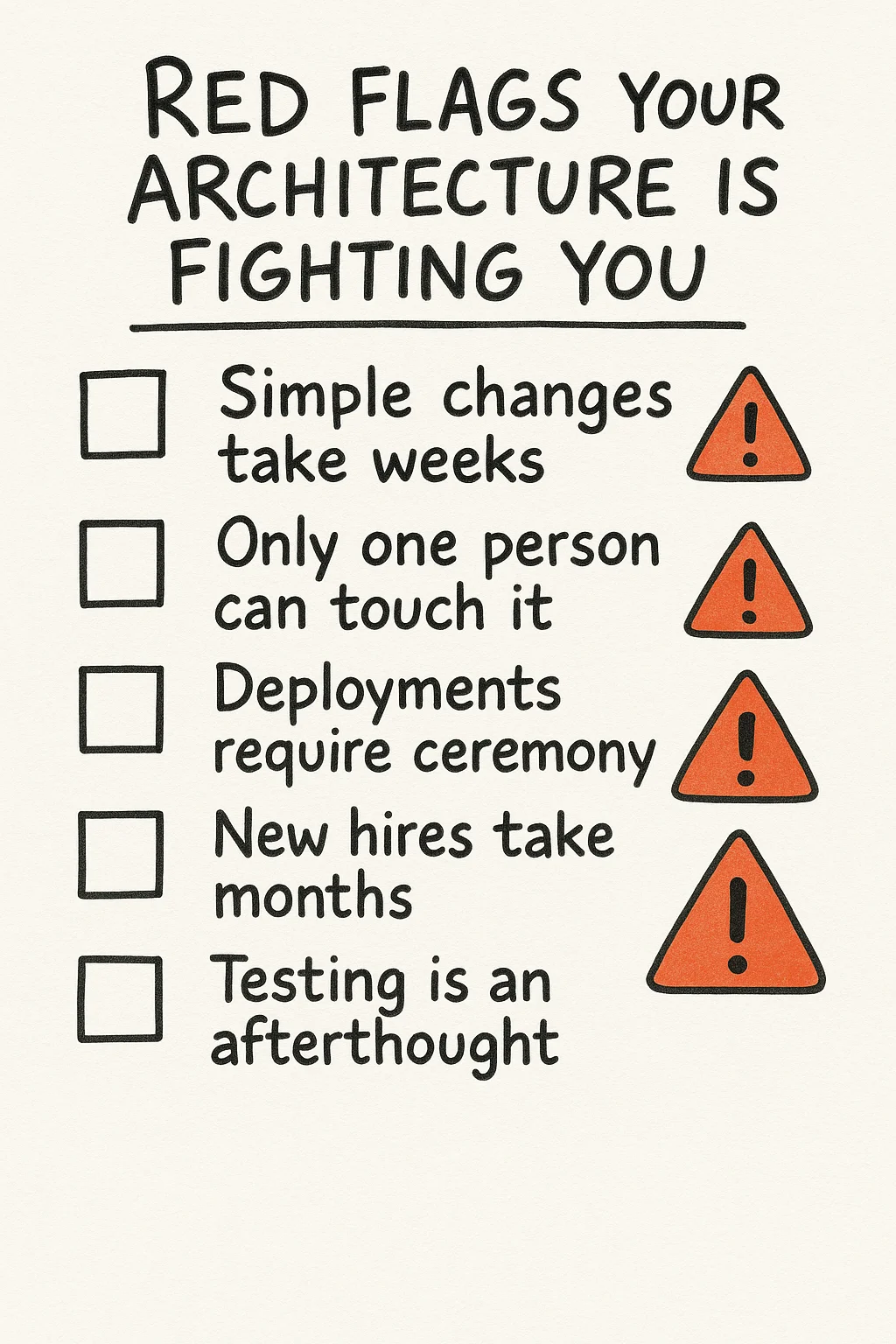
These five symptoms mean your architecture is working against you. And most leaders miss them.
Poor architecture doesn’t announce itself. It whispers through symptoms that leaders often dismiss as “normal” or blame on individuals. Here are five red flags:
1. Simple changes take weeks. “It’s just a field change.” Three sprints later, you’re still waiting. When small changes cascade through multiple systems, your boundaries are wrong.
2. Only one person can touch it. Knowledge concentration isn’t a people problem-it’s a coupling problem. If one person’s absence stops progress, your architecture created that dependency.
3. Deployments require ceremony. War rooms, deployment windows, all-hands-on-deck releases. High-risk deployments reveal tight coupling and missing safety nets.
4. New hires take months to contribute. Extended onboarding isn’t about hiring quality. It’s about cognitive load. If understanding your system requires knowing all of it, your architecture lacks clear boundaries.
5. Testing is an afterthought. When systems are hard to test, teams stop testing. The architecture makes the right thing hard and the wrong thing easy.
These aren’t random problems. They’re architecture telling you something is wrong. If you’re seeing these symptoms, a platform review can help you understand where technical debt lives and what to fix first. It’s worth revisiting what good data architecture looks like and where yours has drifted.
The question isn’t whether you have these symptoms. It’s whether you’re treating them as signals or noise.
How many of these red flags would your team recognize as architecture problems?