Hybrid work changed how your data team collaborates. Nobody adjusted the archite
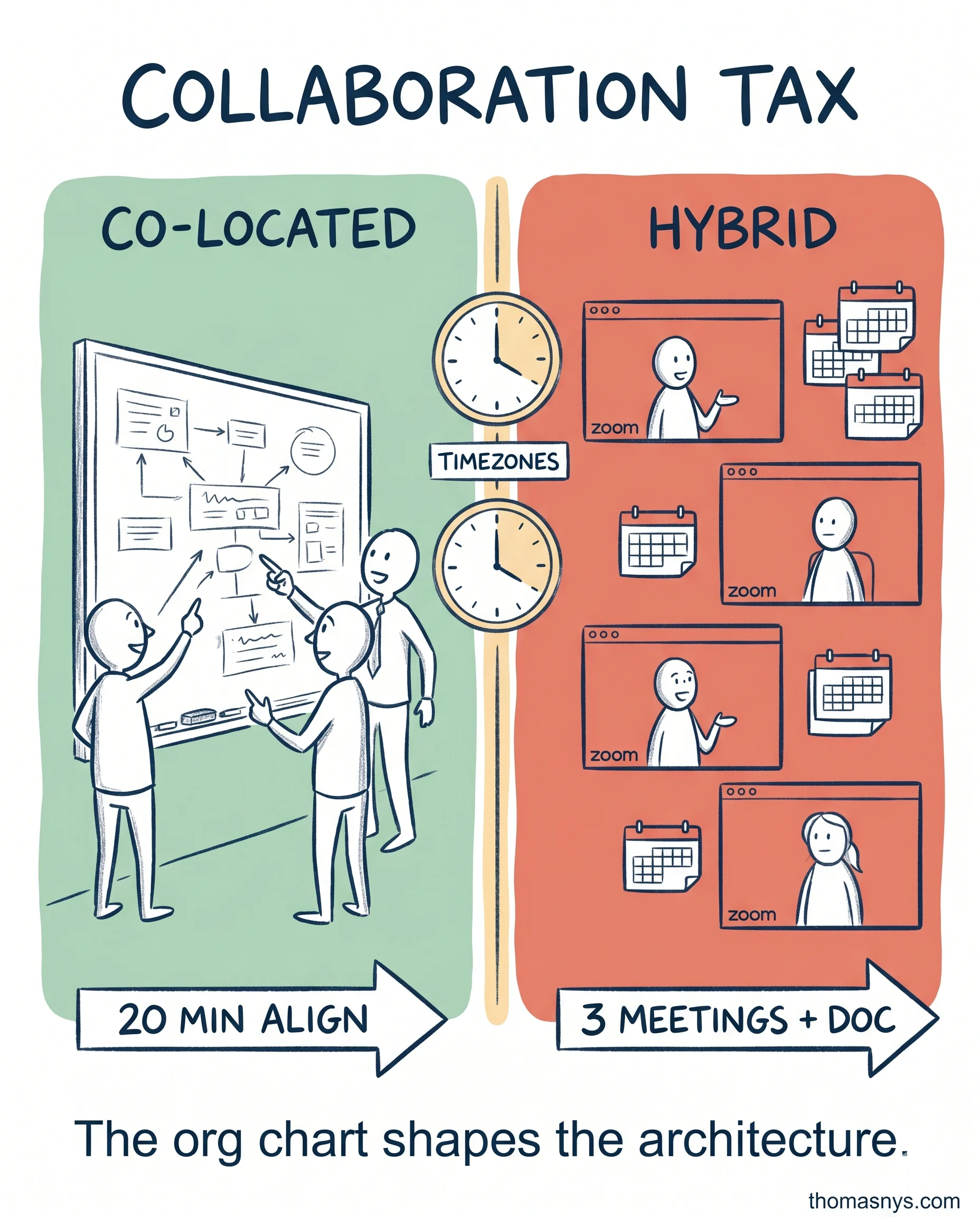
Hybrid work changed how your data team collaborates. Nobody adjusted the architecture decisions for it.
Most data architectures still assume the team can grab a whiteboard and align in 20 minutes. That assumption broke in 2021 and never came back.
The collaboration tax shows up in three ways.
More meetings. The whiteboard alignment didn’t disappear - it became three Zooms across two timezones, plus a follow-up doc nobody reads.
Slower decisions. Async works for “review my PR.” It doesn’t work for “should we adopt Data Mesh.” Architecture decisions need synchronous alignment, and nobody’s calendar has a free hour.
Duplicated work. The Berlin team builds a dashboard. The Austin team builds the same dashboard six weeks later because nobody knew. The catalog says it exists somewhere, but discovery is broken.
Two things move the needle: explicit data ownership (every domain has one named owner, written down, and everyone knows who) and architecture decision records (every non-trivial choice gets a one-page ADR with context, alternatives, decision, consequences).
ADRs feel like overhead until the third time someone asks “why did we pick this.” Then they pay for themselves.
Conway’s Law in 2026: the org chart shapes the architecture. If your org went hybrid and the architecture didn’t change, you’re paying the tax whether you see it or not.
How has remote/hybrid changed the way your data team makes decisions?
Fractional Data Architect helping startups and scaleups build data platforms that scale.
More about Thomas Nys →