FinOps for Data Audit Checklist (8 Cost Levers)
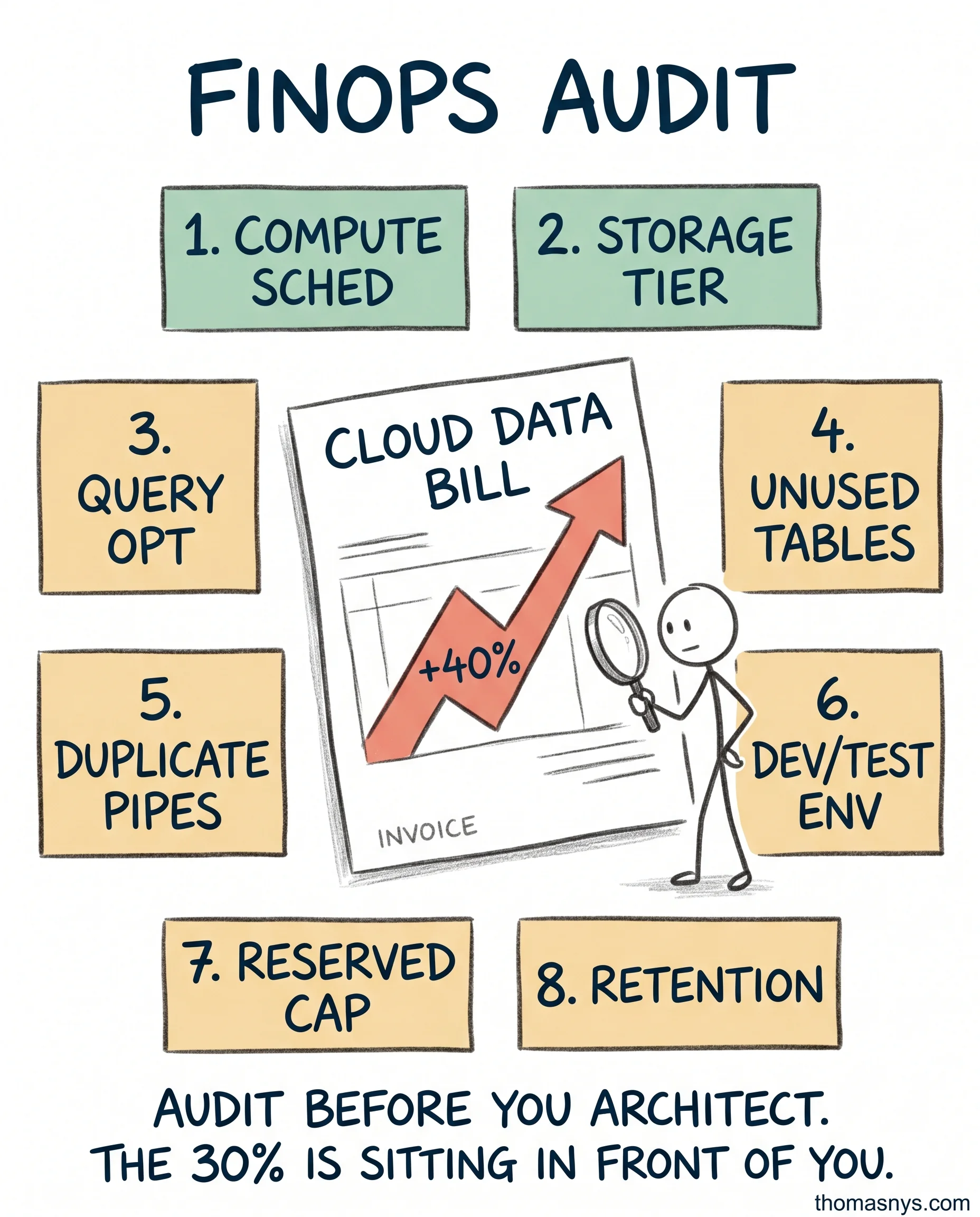
Your cloud data bill grew last year. Can anyone explain which workloads drove it?
This conversation happens at almost every scaleup I work with. Snowflake, BigQuery, Databricks - the bill compounds quietly until finance flags it. Then everyone scrambles for a “cost optimization initiative.”
Skip the initiative. Run an audit. Eight places to look:
- Compute scheduling. Are warehouses running 24/7 when nobody’s querying overnight? Auto-suspend after 1 minute of idle.
- Storage tiering. Cold data on hot storage is wasted spend. Move historical partitions to cheaper tiers.
- Query optimization. Rank queries by actual cost, then inspect the expensive recurring patterns.
- Unused tables. Run a lineage scan. Tables with zero reads in 90 days are candidates for deletion.
- Duplicate pipelines. Two teams built the same customer rollup independently. You’re paying twice.
- Dev and test environments. Almost always over-provisioned and never spun down. Quick win.
- Reserved capacity. If usage is predictable, compare the provider’s current commitment price with on-demand before buying.
- Data retention policies. You’re keeping 7 years of event-level logs because nobody set a policy.
Compute scheduling and storage tiering are often the first places worth checking because the usage evidence is visible and the changes are reversible.
The trap: chasing a warehouse migration or platform rebuild before doing this audit. The obvious waste in the current platform is cheaper to inspect than a migration whose business case hasn’t been established.
Audit first. Architect second.
When was the last time someone audited your data infrastructure costs?
Fractional Data Architect helping startups and scaleups build data platforms that scale.
More about Thomas Nys →