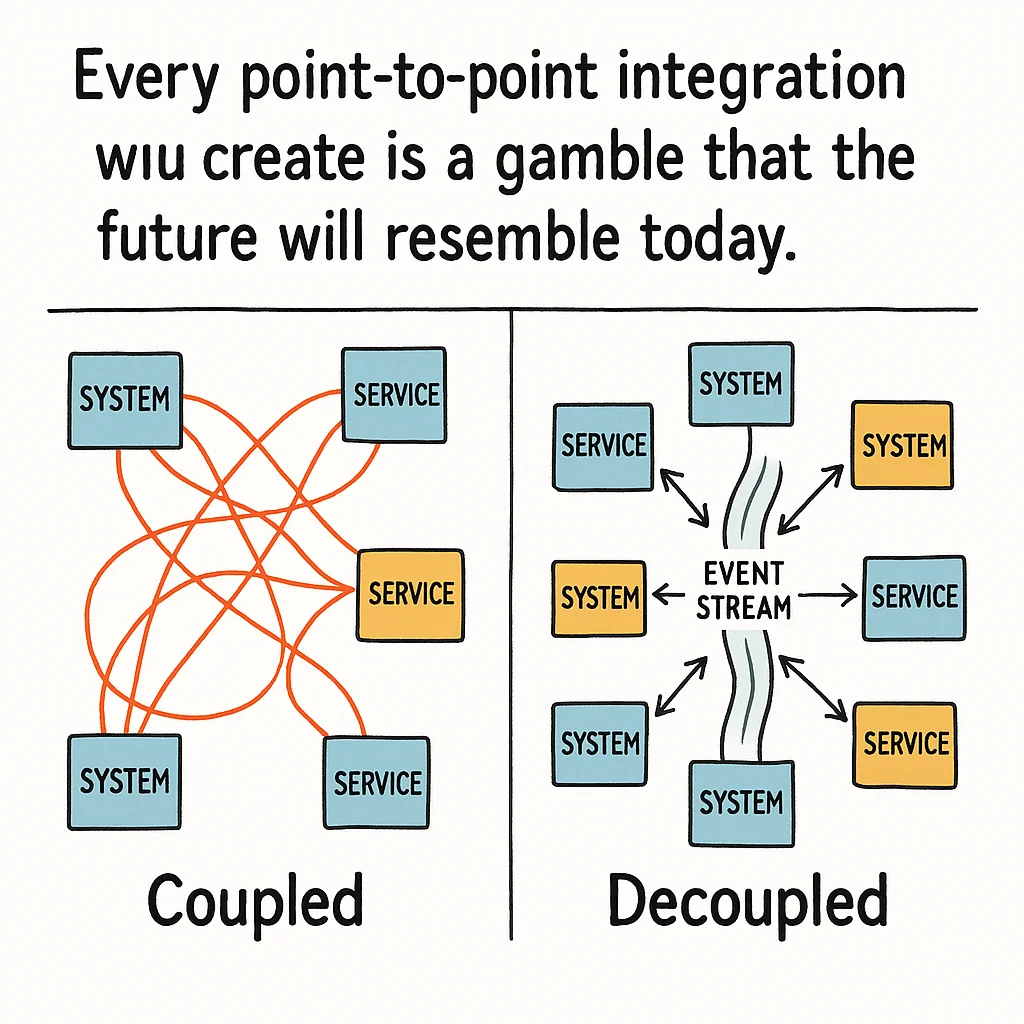
Every point-to-point integration you create is a gamble that the future will resemble today. Event-driven architecture recognizes that it won’t.
The main issue with request-response integration isn’t speed. It’s coordination.
Every synchronous call creates a dependency between teams. Team A can’t ship until Team B exposes the correct endpoint. Team B can’t change its API without coordinating with every consumer. Multiply this across 50 services, and you’ve built an organization where shipping requires a committee.
Event-driven architecture eliminates this by removing temporal coupling entirely.
Instead of services calling each other, they publish what happened. New consumers appear without needing upstream changes. Teams ship when they’re ready, not when everyone else is. Coordination overhead drops to nearly zero.
This is the only integration pattern that allows teams to move independently at scale.
The cost is conceptual: eventual consistency, idempotency, and event versioning. Most organizations underestimate this transition. However, the alternative-synchronous coordination-acts as a bottleneck to every release and is worse.
The question isn’t whether your systems need events. It’s whether your current integration pain is worth the coordination tax you’re paying every sprint.
What is the most fragile integration in your estate right now, and what coupling assumption is keeping it there?