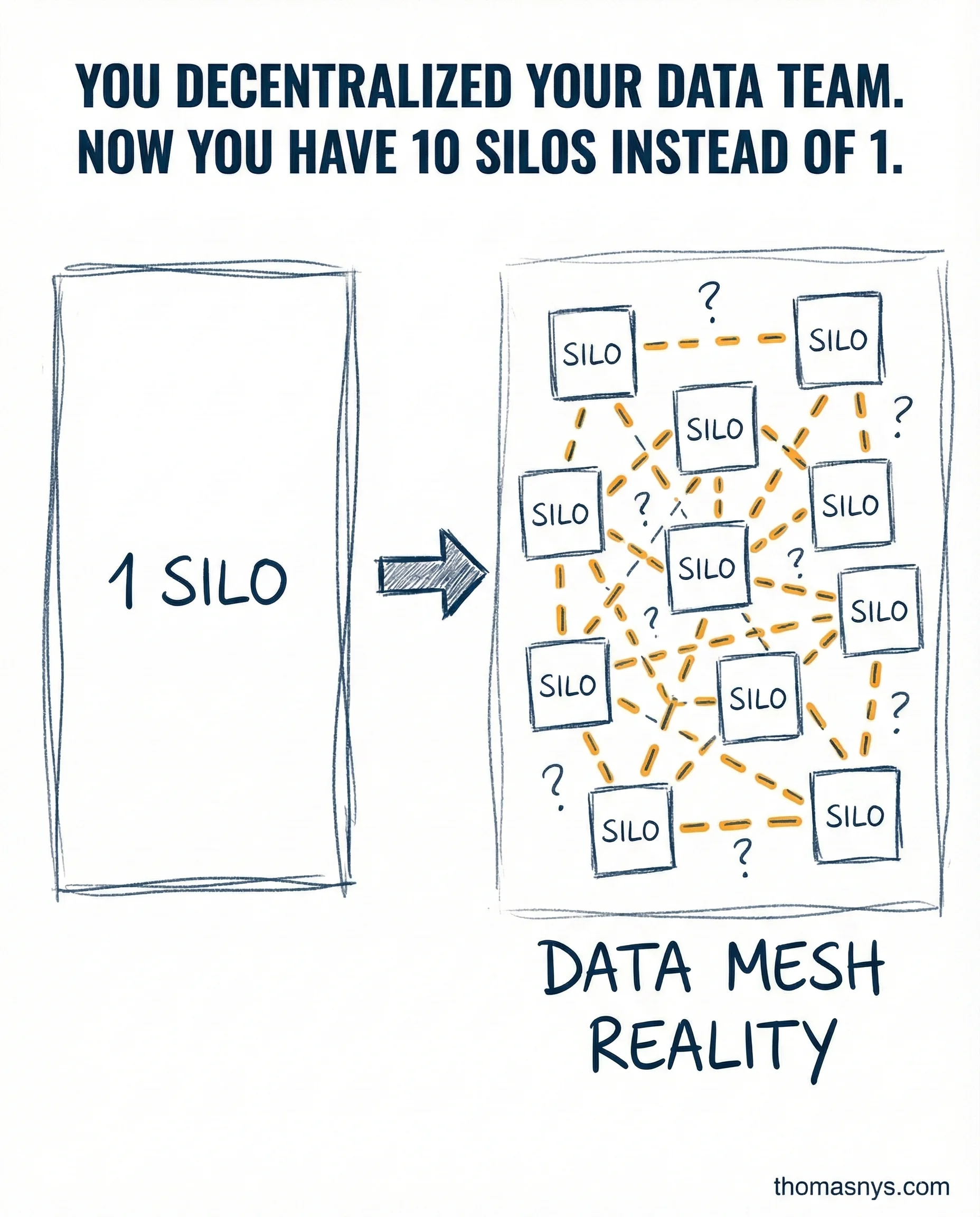
You decentralized your data team. Now you have 10 data silos instead of 1.
Data mesh promised to eliminate silos. So why do they keep coming back?
Three reasons:
1. Nobody owns the in-between. Domain teams own their slice. But cross-domain data? Orphaned. According to Gable.ai: “Determining clear ownership boundaries can be difficult.” Competing priorities make it worse.
2. Changes break things silently. A producer changes something upstream. Your dashboard breaks downstream. Nobody told you. Now it’s your problem to fix.
3. Coordination shifts, it doesn’t disappear. Centralized teams handle coordination implicitly. Decentralized teams need explicit contracts, clear handoffs, shared standards. Most skip that part.
The irony: data mesh requires more governance, not less. Stronger contracts, not weaker ones.
Teams adopt mesh as a technology pattern. They forget it’s an operating model. The architecture changes. The behavior doesn’t. Data mesh is an architectural pattern - before choosing it, understand the fundamentals of data architecture and whether your organization is ready for distributed ownership.
Silos return when coordination fails. Mesh didn’t fail - the operating model did.
Has your data mesh created new coordination problems? Or solved old ones?