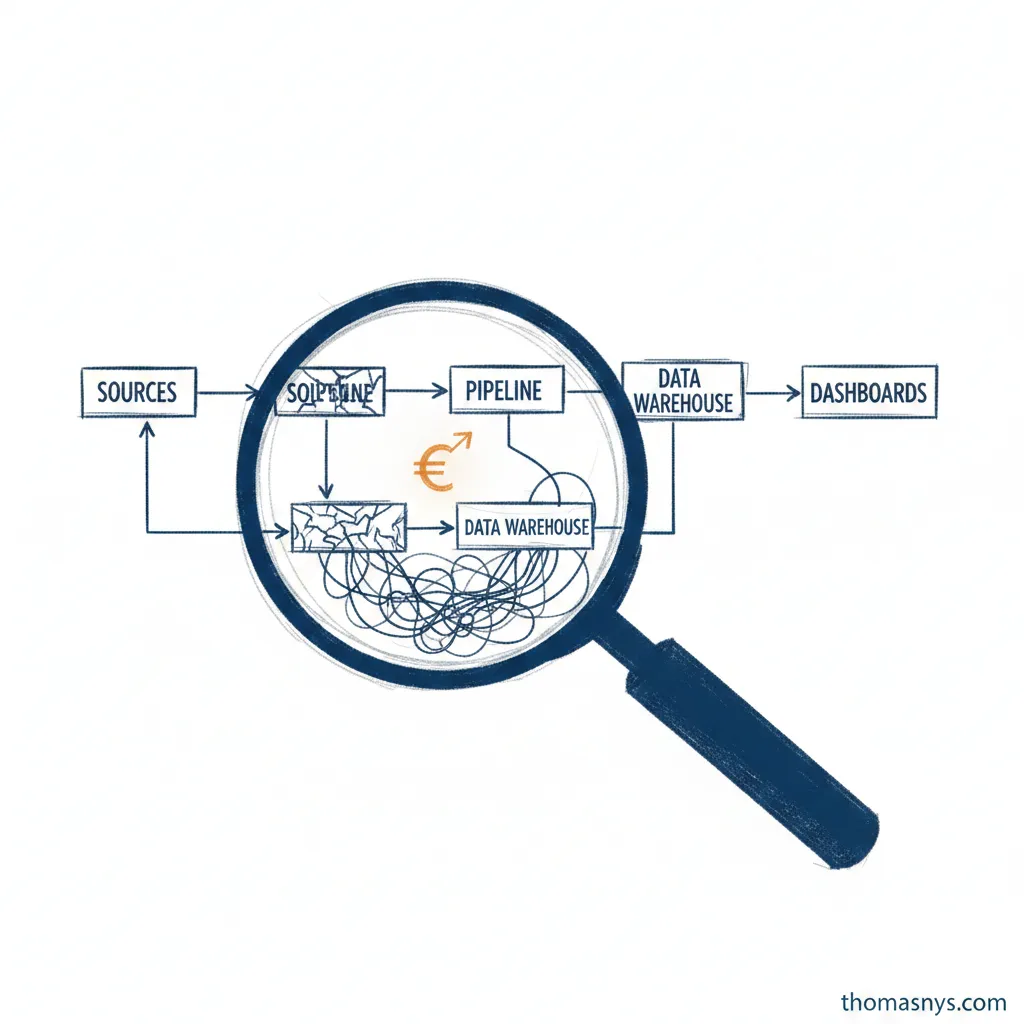
Most teams skip the architecture review. They ship fast, patch what breaks, and hope the platform holds. It usually does - until it doesn’t.
I’ve run architecture reviews for scaleups, Series B startups, and SMEs across Belgium and the EU. The pattern is almost always the same: someone calls me after the platform has been painful for months. The review takes 10 days. The problems it finds have been compounding for years.
Here’s what’s actually involved.
What a Data Architecture Review Covers
A proper data architecture review isn’t a checkbox exercise. It’s a senior architect sitting with your systems, your team, and your constraints to understand what’s working, what’s broken, and what’s about to break.
Architecture and Data Flows
This is the foundation. How does data actually move through your organization? Source systems to ingestion, transformation to storage, storage to consumption. I map the full picture because most teams don’t have it documented.
What I’m looking for: bottlenecks where data queues up, single points of failure that nobody’s noticed, places where data quality degrades silently. The architecture diagram your team drew 18 months ago? It’s usually wrong by now.
Technical Debt Mapping
Every platform accumulates shortcuts. Early decisions made under deadline pressure become permanent fixtures. The question isn’t whether you have debt - it’s whether you know where the expensive debt lives.
I categorize what I find:
- Active drag - debt that’s slowing your team right now (pipeline failures, manual workarounds, brittle dependencies)
- Ticking clock - debt that’s fine today but will hurt at 2x your current scale
- Safely ignorable - shortcuts that aren’t worth fixing
Not everything needs attention. The review tells you what does.
Cost Driver Analysis
Cloud costs rarely come from one place, but they’re usually concentrated. In most reviews I’ve done, 20% of workloads drive 80% of the bill. Full-refresh jobs on tables that change 0.1% daily. Hot storage for data nobody’s queried in a year. Over-provisioned compute running 24/7 for workloads that run 2 hours a day.
One client was spending EUR80K/month on Snowflake and Databricks. Six weeks after the review, they were at EUR45K. Same dashboards, same reports. The waste was just invisible until someone looked.
Team and Process Friction
This is the part most technical audits skip, and it’s often where the biggest problems live.
- Who owns what? (Usually nobody, which means everybody’s pointing at everybody else when something breaks.)
- Where do handoffs fail? If getting data from source to dashboard requires three teams and a Jira ticket, that’s not a process - it’s a bottleneck.
- Where does work get stuck waiting? Access requests, change approvals, deployment queues.
Architecture problems often trace back to people problems. I’ve learned that the hard way - I spent the first few years of my career optimizing pipelines when the real constraint was organizational.
The Question I Start With
In week one of any review, I ask the same question: “Does leadership understand what your data team actually does?”
If the answer is silence or vague gestures toward “dashboards,” I know the real problem. The data team has become a service desk. They build whatever’s loudest, not whatever matters. No architecture review can fix that without addressing the organizational context first.
The second question: “When was the last time you changed a core schema?” If the answer is nervous laughter, I know the platform has calcified. Nobody mapped the dependencies, so every change feels like defusing a bomb. That’s not stability. That’s lost velocity.
These questions don’t need code access. They tell me whether we’re solving a technical problem or an organizational one. Usually it’s both.
What Changes After a Review
I won’t pretend every review is revelatory. Sometimes the findings confirm what the team already suspected. But there’s a difference between suspecting and having it documented with severity ratings, business impact, and a sequenced plan.
What typically shifts:
Clarity on priorities. Before the review, everything feels urgent. After, you know which three things to fix first - and which twenty things to deliberately ignore.
Shared language between tech and business. The review creates a document that both your CTO and your CFO can read. Technical debt stops being abstract and becomes “this costs us EUR12K/month in wasted compute.”
Confidence for big decisions. Considering a migration? Evaluating Snowflake vs BigQuery? The review gives you data to decide with, not opinions to debate.
An executable backlog. Not a PowerPoint deck. A sequenced 90-day plan with scope, success criteria, dependencies, and effort estimates for each item.
When You Don’t Need a Data Architecture Review
I’ll be honest - not every company needs one. If your platform is simple, stable, and serving the business well, a review won’t find much. Save your money.
You probably don’t need a review if:
- Your data team is small (1-3 people) and the platform is straightforward
- You’re pre-product-market-fit and still figuring out what data you need
- The problem is clearly execution speed, not architecture direction
But if your pipelines break regularly and nobody fully understands why, if cloud bills are climbing faster than usage, if you’re preparing for a funding round and need to understand your technical debt exposure - that’s when a structured review pays for itself many times over.
Related Reading
- The False Economy of Skipping Architecture Reviews - Why the “we’ll review after launch” approach costs months
- Red Flags: Symptoms of Poor Architecture - How to spot problems before they compound
- What Is Data Architecture? - The fundamentals behind any review
- Platform Review: What I Find in Week One - Five common problems
Considering a review? Book a 30-minute call to discuss whether it makes sense for your situation.