Consolidating from 15 tools to 7 in 2026. Three drivers, none of them innovation
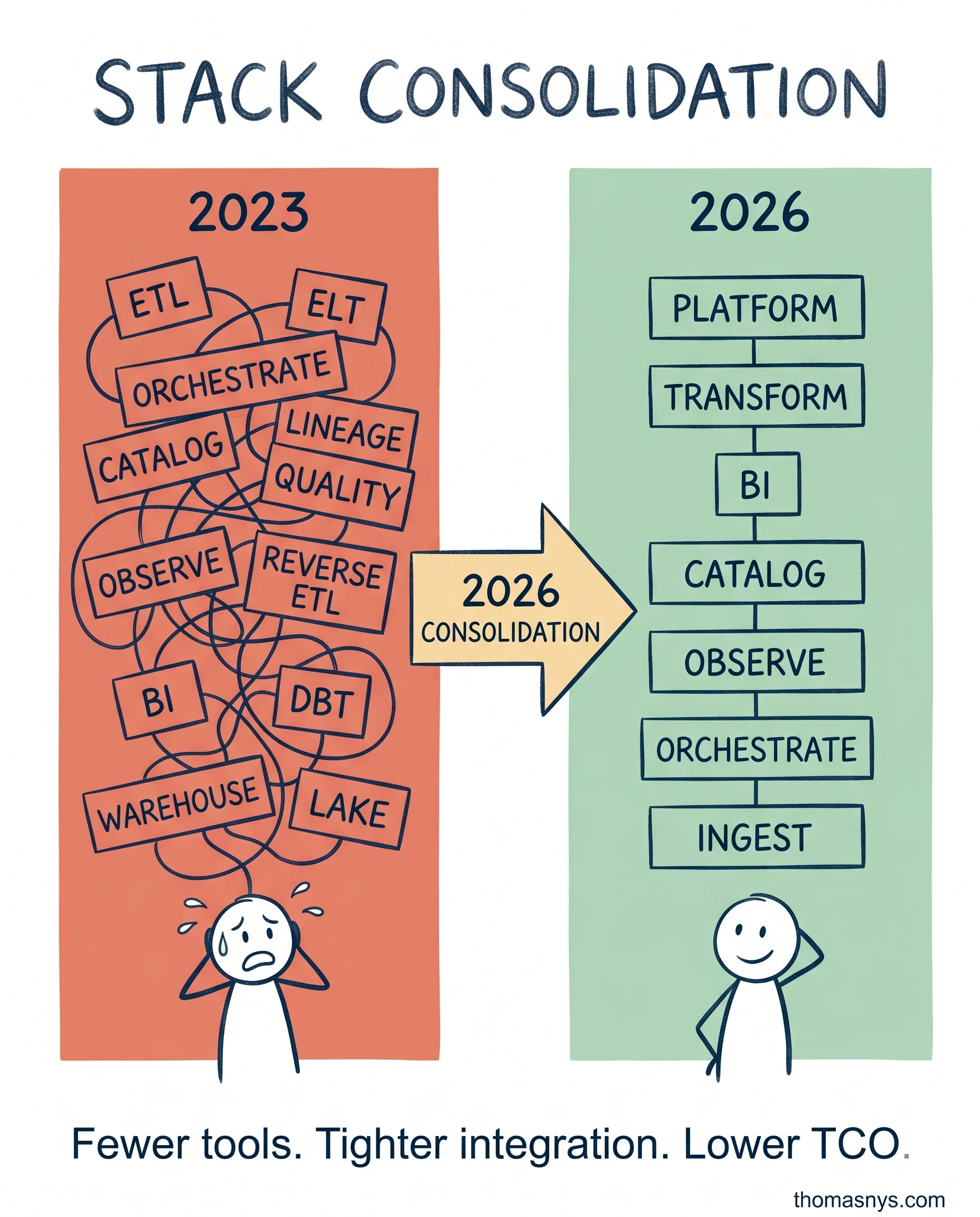
Consolidating from 15 tools to 7 in 2026. Three drivers, none of them innovation.
2020 to 2023 was the proliferation era. Specialized tools for everything. Ingestion. Transformation. Reverse ETL. Lineage. Catalog. Quality. Observability. Orchestration. Each one a separate vendor, each one a separate contract, each one a separate integration to maintain.
In 2026, that’s reversing.
Three drivers I’m seeing across clients. Budget pressure - CFOs are asking why one team has 15 SaaS contracts. Integration complexity - every new tool is a new failure mode. Talent shortage - hiring for 15 specialty tools is harder than hiring for 7 platforms.
Where the consolidation is happening: Databricks and Snowflake are absorbing capabilities. Catalog, lineage, quality checks, semantic layer - all of these used to be separate products. Now they ship inside the warehouse.
The math is changing too. A point solution that’s 20% better isn’t worth $100K/year if the platform’s built-in version is “good enough” and free.
The trap I’d flag: don’t consolidate just to consolidate. Some specialized tools are genuinely better at their narrow job. The question to ask is whether the capability gap is worth the integration cost. If your dbt setup works and your team knows it, ripping it out for a Snowflake-native equivalent because of a procurement directive is a step backwards.
Audit your stack. Map every tool to a capability. Find the redundancy. Cut what’s redundant. Keep what’s specialized and load-bearing.
How many tools are in your data stack? Could you remove 3 without losing capability?
Fractional Data Architect helping startups and scaleups build data platforms that scale.
More about Thomas Nys →