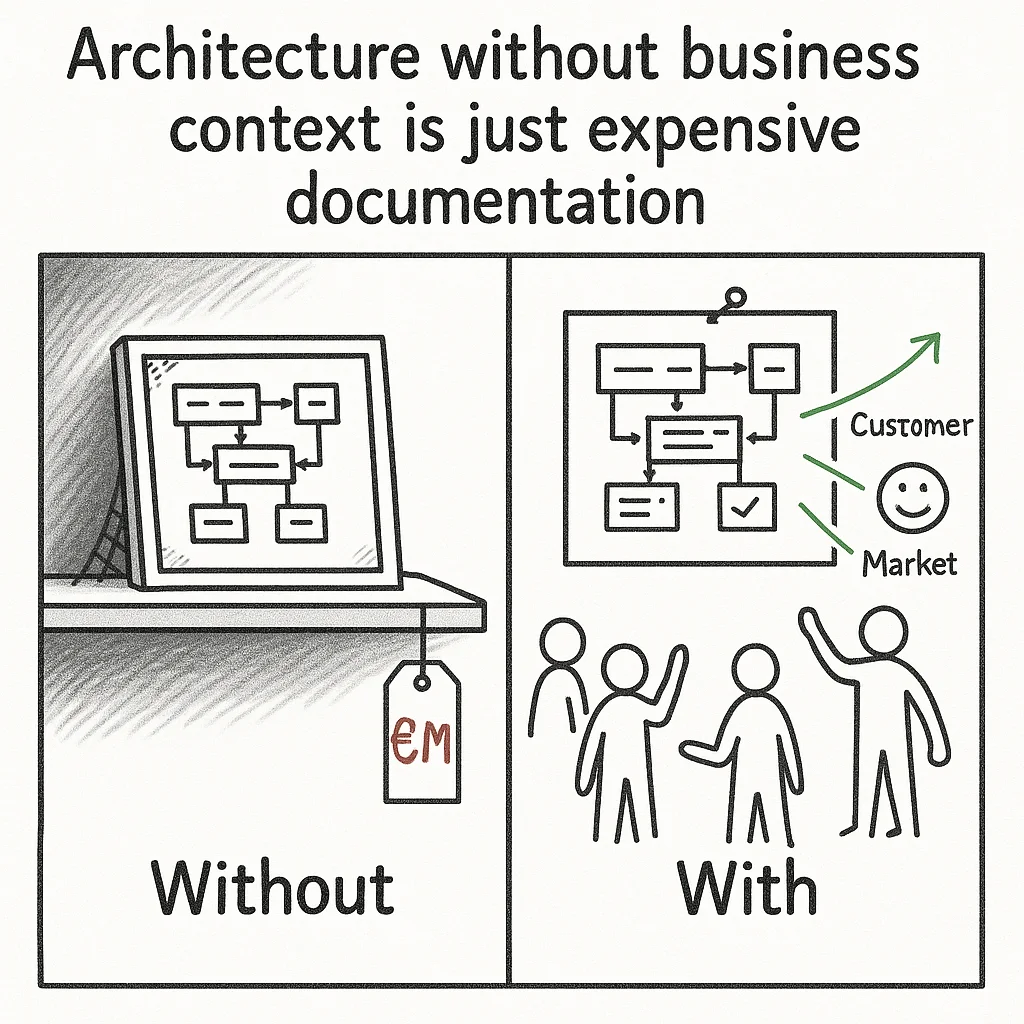
Architecture without business context is just expensive documentation.
When architecture and business strategy diverge, it causes organizational gridlock. Engineers focus on what interests them. Leadership allocates funds to what’s urgent. Neither wins. The business stalls.
Here’s what happens:
Your platform team spends six months decomposing the monolith because “microservices scale better.” Meanwhile, the business needs faster feature delivery on the existing product to meet revenue targets. No one asked if decomposition was the bottleneck. It wasn’t. But you’ve spent €3M in engineering time solving the wrong problem.
The core problem isn’t technical skill; it’s organizational disconnection.
Architecture decisions made in a vacuum become optimization exercises disconnected from what drives value. Engineers make technically sound choices that business leadership can’t defend to the board. Budgets get cut, Roadmaps stall. Everyone blames each other.
The fix is forcing translation at the decision point.
Before you decompose that monolith, ask: what business outcome does this enable? Faster deployments to capture market opportunities? Reduced operational cost to improve margin? Regulatory compliance to enter new markets?
If your architects can’t connect their work to business outcomes, the work shouldn’t be funded. If leadership can’t articulate the technical constraint, the strategy won’t survive contact with reality.
What’s the last architectural investment you killed because the business case didn’t hold up or should have?