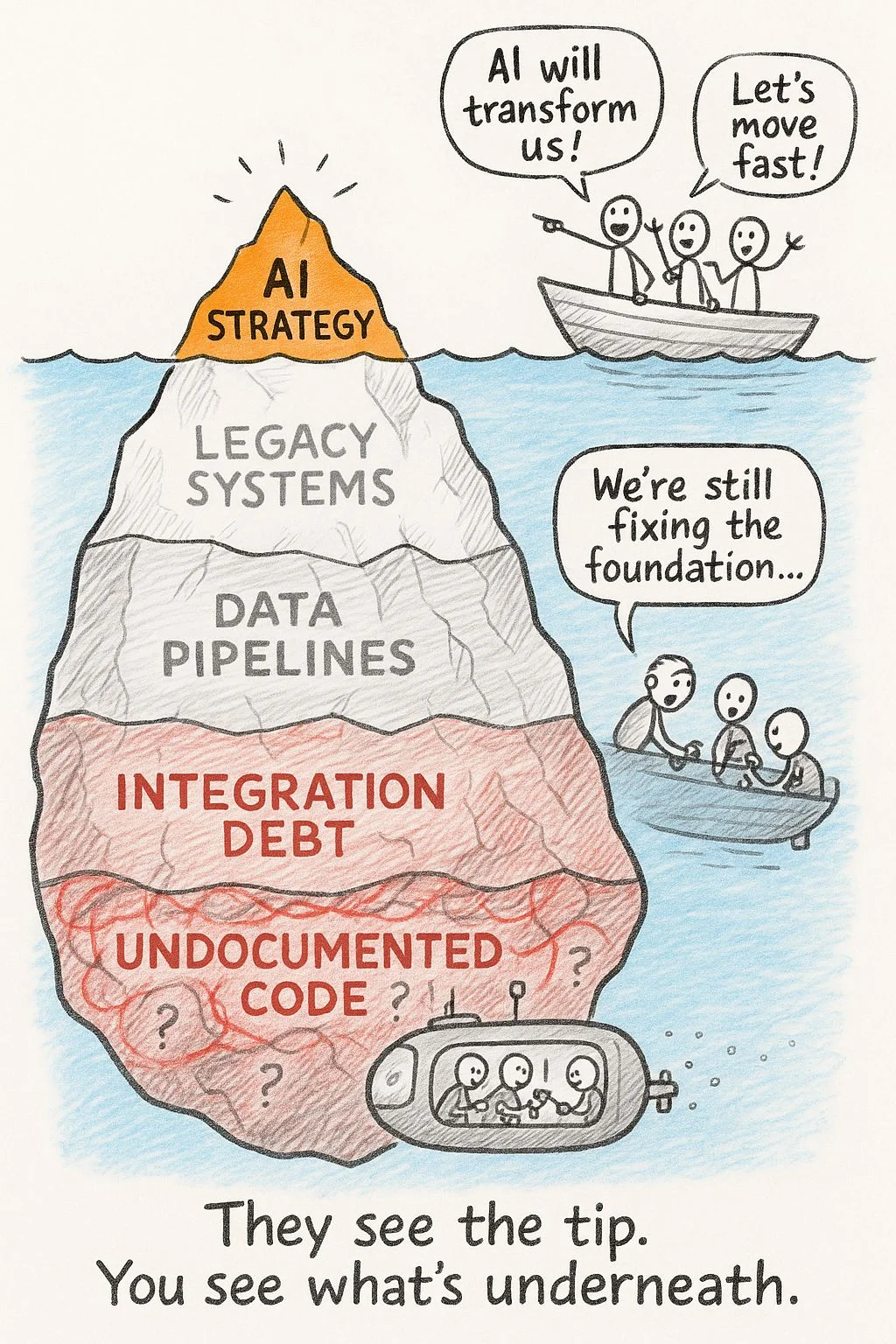
Your engineers spend 40% of their time maintaining yesterday’s shortcuts. And you’re wondering why your AI initiative isn’t moving faster.
McKinsey estimates that 20-40% of the tech estate’s value goes to debt. Gartner flags 40% of infrastructure systems carry debt concerns. The math is brutal: a massive chunk of your IT investment goes to maintenance, not innovation.
Here’s what that means in practice:
You hired 10 engineers. 4 of them are effectively maintaining legacy decisions. The other 6 are building new features while simultaneously creating tomorrow’s maintenance burden.
And it adds up. Every shortcut taken under deadline pressure becomes next quarter’s tax. Every “we’ll fix it later” becomes someone’s full-time job.
This isn’t visible in most dashboards. There’s no line item for “capacity lost to accumulated shortcuts.” It just appears as slowness, missed deadlines, or attrition from burned-out engineers.
Meanwhile, the board wants AI. Everyone wants AI. But here’s what nobody’s saying in those strategy meetings: you can’t layer AI on a foundation that’s already consuming 40% of your capacity just to stay standing.
Every AI pilot that stalls, every POC that can’t scale, look underneath. You’ll find data pipelines held together with duct tape. Integration layers that require three engineers to understand. Systems so fragile that deploying a model means risking production.
The companies leading with AI in 2025 aren’t necessarily the ones with the largest teams or best models. They’re the ones whose engineers spend 80% of their time focusing on progress rather than fixing issues. They prioritized fixing the foundation before adding intelligence.
What percentage of your engineering capacity is spent on maintenance vs. innovation?