The Short Version
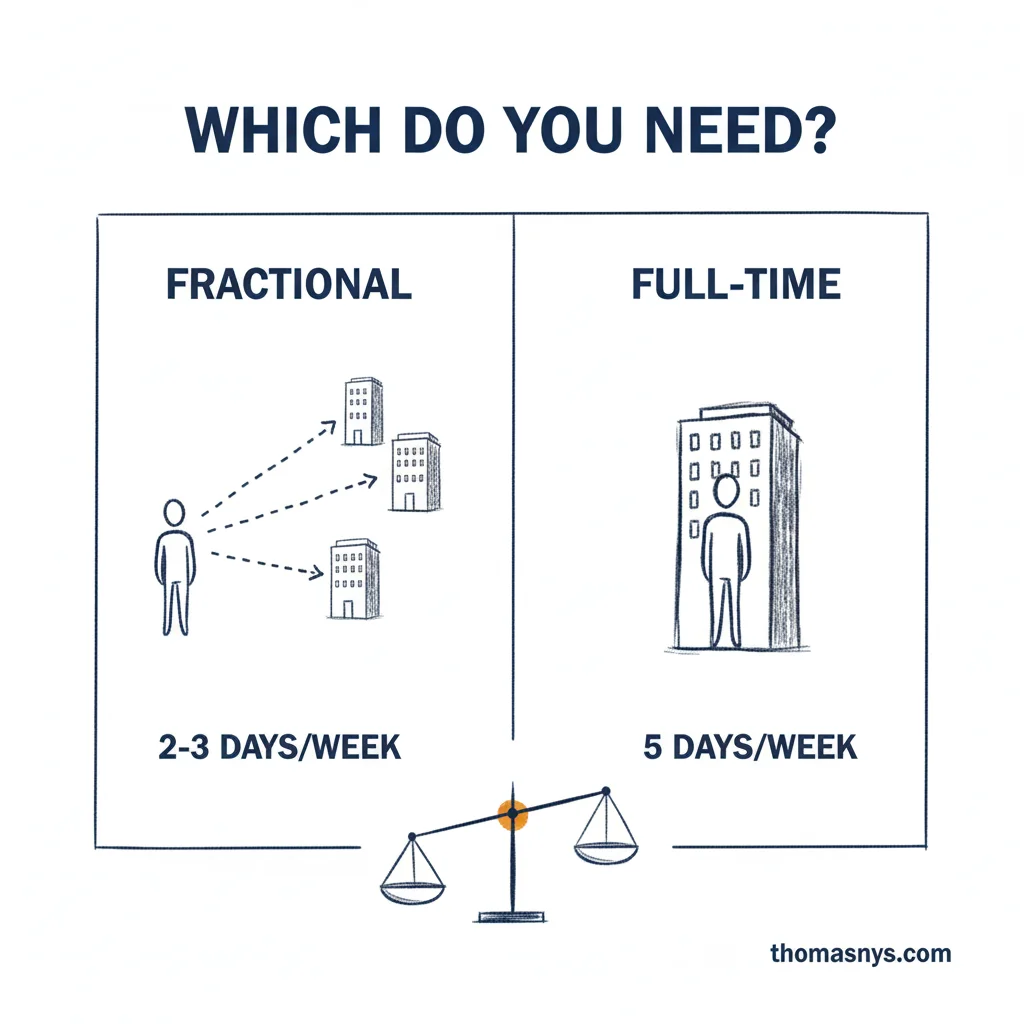
A fractional data architect works with your company 1-3 days per week on an ongoing basis. You get senior architecture leadership at 30-50% of the cost of a full-time hire, without the recruiting timeline or long-term commitment.
A full-time data architect is embedded 5 days per week and fully dedicated to your organization. Higher cost, deeper context, but harder to find and slower to onboard.
The honest answer: Most startups and scaleups (10-200 people) don’t need a full-time data architect. They need 2-3 days per week of senior architecture thinking. The rest of the week, their existing engineers can execute on a clear plan.
Cost Comparison
| Dimension | Fractional Data Architect | Full-Time Data Architect |
|---|---|---|
| Annual cost | €75,000-150,000 (2-3 days/week) | €120,000-200,000+ (salary + benefits + overhead) |
| Recruiting time | Days to weeks | 3-6 months (senior architects are scarce) |
| Onboarding | 1-2 weeks to productive | 1-3 months to fully effective |
| Commitment | Monthly or quarterly | 12-24 month effective commitment |
| Risk if wrong fit | Low - end the engagement | High - severance, re-recruiting, lost time |
| Availability | 1-3 days/week (scheduled) | 5 days/week (dedicated) |
| Cross-industry insight | Yes - works with 2-4 clients simultaneously | Limited to your organization |
| Notice period | 2-4 weeks typical | 1-3 months typical |
The cost difference is significant, but it’s not just about money. It’s about what you actually need.
When a Fractional Data Architect Makes Sense
A fractional model works when:
You’ve outgrown your current setup but aren’t ready for a full-time Head of Data
This is the most common scenario. Your platform “works” but things keep breaking, cloud costs are climbing, and your engineers spend more time firefighting than building. You need someone senior to set direction, make the hard calls, and mentor the team. But there isn’t 5 days per week of architecture work to do.
You need to make critical decisions now
Choosing between Snowflake and Databricks. Planning a migration. Deciding whether to rebuild or refactor. These decisions have long-term consequences, and getting them wrong is expensive. A fractional architect with experience across multiple companies has seen what works and what fails.
Your team is strong but lacks architecture leadership
You have good engineers who can execute. What they lack is someone who sees the whole system - who can connect the infrastructure decisions to business outcomes, resolve technical debates, and keep the platform evolving intentionally rather than accidentally.
You can’t afford to wait 6 months for a hire
Recruiting a senior data architect takes 3-6 months in most markets. A fractional engagement can start within weeks. For companies where data problems are actively costing money or slowing growth, that timeline difference matters.
You want pattern recognition from multiple contexts
A fractional architect working with 2-4 companies simultaneously brings cross-pollinated insights. They’ve seen what works at your stage because they’re working with companies at similar stages right now. A full-time hire, by definition, only sees your organization.
When a Full-Time Data Architect Makes Sense
The full-time model is better when:
Your data organization is large enough to need daily architecture leadership
If you have 10+ data engineers, multiple data products, and complex cross-team dependencies, there’s genuinely 5 days per week of architecture work. At that scale, the context-switching cost of a fractional model starts to outweigh the benefits.
You’re in a heavily regulated industry with compliance requirements
Healthcare, financial services, and government often require dedicated staff for compliance reasons. While a fractional model can work technically, organizational and regulatory constraints may favor a full-time hire.
Your architecture is the product
If you’re building a data platform as your core product (not as internal infrastructure), the architect needs to be deeply embedded in product decisions, customer feedback, and engineering execution every day.
You’ve already validated the role with a fractional engagement
One of the best paths to a successful full-time hire is starting fractional. You learn what the role actually looks like in your organization, what skills matter most, and what kind of person thrives in your culture. Then you hire with confidence instead of hope.
What Does a Fractional Data Architect Actually Do?
There’s a common misconception that “fractional” means less committed or less effective. In practice, a good fractional architect focuses on the highest-leverage activities:
Architecture direction - Platform decisions, technology selection, system design. The decisions that compound over months and years.
Technical standards - Code review practices, data governance frameworks, documentation standards. Setting the bar so engineers can execute consistently.
Cross-team alignment - Breaking down silos between data, product, and ops teams. Making sure everyone’s building toward the same target.
Mentoring - Leveling up your engineers so they can handle more complexity independently. The goal is building capability, not dependency.
Decision unblocking - When teams are stuck on technical debates or trade-off decisions, having someone senior who can listen, synthesize, and decide.
What a fractional architect typically doesn’t do: daily standup attendance, operational on-call, writing every pipeline, or managing individual contributors. Those are better handled by your full-time team.
The Hybrid Path
Many companies I work with follow this pattern:
Phase 1: Fractional (3-12 months) Bring in a fractional data architect to assess the current state, set direction, build standards, and mentor the team. This is where you learn what architecture leadership actually looks like in your organization.
Phase 2: Decision point After 6-12 months, you’ll know whether you need a full-time architect or whether the fractional model continues to serve you. Some companies hire full-time. Many find that 2 days per week of senior architecture input, combined with a team that’s leveled up, is exactly right.
Phase 3: Advisory (ongoing) Even after hiring full-time, many organizations keep a fractional advisory relationship - a few hours per month for second opinions, sounding board conversations, and external perspective. This costs very little and prevents the tunnel vision that comes from only seeing your own systems.
How to Evaluate a Fractional Data Architect
Not all fractional engagements are equal. Look for:
Hands-on experience, not just frameworks. Someone who has built and operated data platforms, not just designed them on whiteboards. Ask about their last production incident. If they can’t describe one, they haven’t been close enough to the work.
Platform independence. A fractional architect with vendor partnerships or certifications will (consciously or not) lean toward those platforms. Look for someone who evaluates based on your needs, not their partnerships.
Clarity about what changes. After the first 2-4 weeks, a good fractional architect should articulate: here’s what I found, here’s what’s working, here’s what’s broken, here’s the plan. If they can’t be specific, they’re not going deep enough.
A defined exit plan. The best fractional engagements build independence. If your fractional architect’s business model depends on you needing them forever, the incentives are misaligned.
Common Objections
“We need someone here every day.” Do you? Or does your team need clear direction and the ability to execute? Most architecture work isn’t daily firefighting - it’s setting the right direction so fires don’t start.
“A fractional person won’t understand our context deeply enough.” In my experience, it takes about 2-4 weeks of embedded work to understand a company’s data landscape well enough to add serious value. After that, the value comes from focused, high-leverage time - not sitting in every meeting.
“It’s too expensive for a part-time engagement.” Compare the total cost: a fractional architect at 2 days/week for a year costs roughly the same as 4-6 months of recruiting plus the first year of a full-time salary. And you get value from week 1 instead of month 6.
“We tried consultants before and it didn’t work.” The difference between a consultant who delivers a report and a fractional architect who’s embedded with your team is enormous. A fractional engagement means ongoing accountability, not a one-time deliverable that sits in a drawer.
My Perspective
I’m a fractional data architect, so I’m obviously biased. But I also turn away companies that genuinely need a full-time hire. The fractional model isn’t right for everyone.
What I’ve seen consistently across dozens of engagements: most companies between 10-200 employees get better outcomes from fractional architecture leadership than from a rushed full-time hire. The combination of lower risk, faster time-to-value, and cross-industry perspective usually wins.
If you’re unsure which model fits, book a 30-minute call. I’ll give you an honest assessment - even if the honest answer is “hire full-time.”