The Short Version
A data governance framework is the structured approach to implementing governance across your organization. It’s not a product you buy - it’s a combination of organizational structure, policies, processes, and tools that work together to ensure data is trustworthy, secure, and usable.
Most governance frameworks fail because they focus on process before problems. They create governance councils, data steward roles, and approval workflows - then wonder why nobody uses them.
The right framework starts with pain: which data quality issue costs you the most? Who’s responsible when it breaks? What decision takes longest because nobody owns the data?
Fix that first. Build the framework around solving actual problems, not implementing theoretical best practices.
What Makes a Data Governance Framework
A governance framework has four components that work together:
1. Organizational Structure
Who makes decisions and who’s accountable:
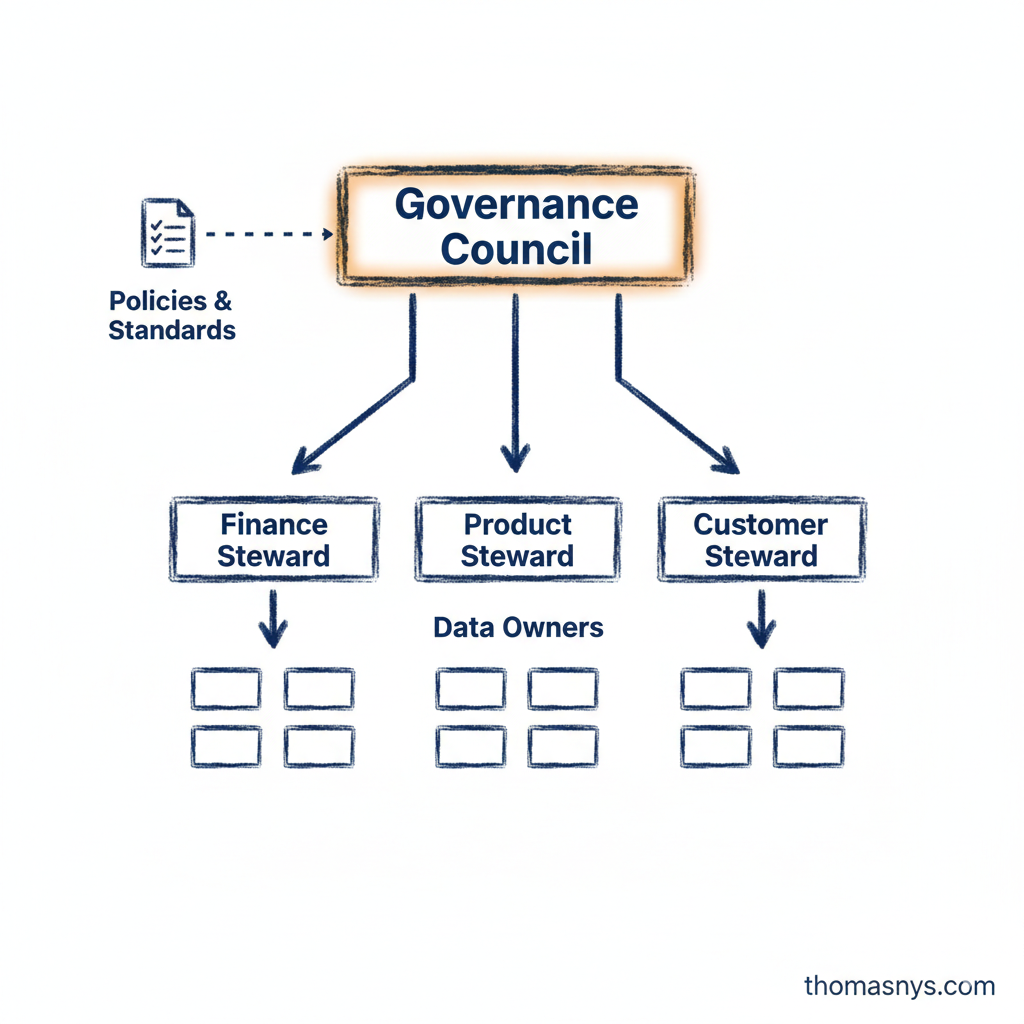
- Data Governance Council - Cross-functional leadership that sets direction and resolves conflicts
- Data Stewards - Business-side owners responsible for data quality in their domains
- Data Custodians - Technical teams that implement governance policies
- Data Owners - Executives accountable for data assets in their areas
The structure answers: “Who decides what ‘customer’ means?” and “Who fixes it when revenue numbers don’t match?”
2. Policies and Standards
The rules that guide data decisions:
- Data classification (public, internal, confidential, restricted)
- Data quality standards and measurement criteria
- Access control policies and approval workflows
- Retention and deletion policies
- Privacy and compliance requirements
Policies without enforcement are just documentation. The framework includes how policies get implemented and monitored.
3. Processes
How governance happens day-to-day:
- Data request and access provisioning
- Issue escalation and resolution
- Change management for data definitions
- Quality monitoring and remediation
- Regular governance reviews
Process should enable, not slow down. If requesting data access takes three weeks, your framework isn’t working.
4. Technology Enablers
Tools that make governance practical:
- Data catalogs for discovery and documentation
- Quality monitoring tools
- Access management systems
- Lineage tracking capabilities
- Audit logging
Technology enforces what humans would forget. Automated quality checks, access reviews, and lineage documentation make governance sustainable.
Types of Data Governance Frameworks
Different organizations need different frameworks. Choose based on size, maturity, and pain points - not industry best practices.
Centralized Framework
One team governs all data:
- Central data team defines standards and approves access
- Consistent rules across the organization
- Clear accountability
Works for: Small to mid-size companies, highly regulated industries, data-sensitive organizations
Breaks when: Central team becomes bottleneck, business units need autonomy, scale exceeds capacity
Federated Framework
Domain teams own their data with central standards:
- Business domains own data quality and definitions
- Central team sets standards and provides platform
- Domains govern within guidelines
Works for: Growing companies, multiple business units, need for speed with control
Breaks when: Domains lack data expertise, standards drift across teams, nobody enforces central policies
Distributed Framework (Data Mesh)
Domains own data as products:
- Full domain autonomy for data
- Platform team provides infrastructure
- Interoperability through standards
Works for: Large organizations, mature data teams, need for domain expertise
Breaks when: Teams lack capability, governance becomes fragmented, discovery across domains fails
Most companies start centralized, move to federated as they grow, and only the largest adopt distributed models.
Related: Data Mesh vs Reality
Framework Maturity Levels
Understand where you are before deciding where to go.
| Level | Characteristics | What to Focus On |
|---|---|---|
| Initial | Ad hoc, reactive, no formal ownership | Assign owners for critical datasets |
| Developing | Basic policies exist, some ownership defined | Document core definitions, establish quality baselines |
| Defined | Documented framework, consistent processes | Automate quality checks, formalize access control |
| Managed | Metrics tracked, continuous improvement | Measure governance impact, optimize processes |
| Optimized | Governance embedded in culture, automated where possible | Scale governance, enable self-service |
Most growing companies are between Initial and Developing. Moving to Defined creates the biggest impact - formal ownership and basic policies address 80% of governance problems.
Don’t skip levels. Initial to Defined is achievable. Initial to Optimized is fantasy.
Building Your Framework
Start minimal and expand based on what works.
Phase 1: Foundation (Weeks 1-4)
Objective: Stop the bleeding on your biggest data problem
Actions:
- Identify the most painful data issue (quality, access, or trust)
- Assign one owner accountable for fixing it
- Define success metrics
- Document the problem and solution
Output: One working example of governance solving a real problem
Phase 2: Core Structure (Months 2-3)
Objective: Establish basic governance capability
Actions:
- Define critical data domains (customer, product, financial, etc.)
- Assign domain owners
- Document 10-20 most important business terms
- Establish access principles (who gets what, how to request)
- Implement automated quality monitoring for critical data
Output: Clear ownership map, core glossary, working access process
Phase 3: Formalization (Months 4-6)
Objective: Scale governance beyond critical domains
Actions:
- Establish governance council (if needed)
- Formalize data steward roles
- Document policies and standards
- Create escalation processes
- Expand quality monitoring
Output: Documented framework that works without key person dependencies
Phase 4: Optimization (Months 7-12)
Objective: Embed governance in culture and workflow
Actions:
- Automate compliance reporting
- Implement self-service data access
- Measure governance impact (time saved, quality improved, cost reduced)
- Iterate based on what’s working
Output: Governance that happens automatically, not through enforcement
Framework Components in Practice
Ownership Model
Every dataset needs an owner - a person (not a team) accountable for:
- Defining what the data means
- Setting quality standards
- Approving access
- Fixing issues when they occur
Simple ownership model:
- One owner per dataset - Not shared, not team ownership
- Clear responsibilities - What owners decide vs what they implement
- Escalation paths - When owners can’t resolve issues, who decides?
- Review cadence - Ownership assignments reviewed quarterly
Related: Data Ownership Model
Policy Framework
Policies should be minimal and enforceable:
Data classification:
- Public: Can be shared externally
- Internal: Company-wide access
- Confidential: Need-to-know basis
- Restricted: Requires approval and audit
Access principles:
- Default deny (request access, don’t assume it)
- Time-limited access for temporary needs
- Regular access reviews
- Audit trail for sensitive data
Quality standards:
- Critical data: 99%+ accuracy, real-time monitoring
- Important data: 95%+ accuracy, daily monitoring
- Reference data: 90%+ accuracy, weekly monitoring
Match standards to consequences. Financial reporting needs higher accuracy than marketing analytics.
Process Design
Effective governance processes are:
Fast: Access requests resolved in hours, not weeks Automated: Quality checks run without human intervention Exception-based: Only escalate what needs decisions Transparent: Everyone knows who owns what and how to request access
Bad process example:
- Submit access request ticket
- Wait for governance council meeting (2 weeks)
- Council reviews request
- IT implements access (1 week)
- User gets access (total: 3+ weeks)
Good process example:
- User requests access through catalog
- System checks if user role qualifies (instant)
- If yes: Access granted automatically
- If no: Request sent to data owner (email notification)
- Owner approves/denies (within 24 hours)
- System provisions access automatically
- Total time: Minutes to 1 day
Technology Stack
A practical governance technology stack includes:
Data Catalog (Atlan, Alation, DataHub, OpenMetadata)
- Discovery: Find data across systems
- Documentation: Understand what data means
- Lineage: Track data flow
- Ownership: Know who’s responsible
Quality Monitoring (Great Expectations, Soda, Monte Carlo)
- Automated quality checks
- Anomaly detection
- Quality metrics and trends
- Alert routing to owners
Access Management (Built into data warehouse, or tools like Immuta, Privacera)
- Role-based access control
- Dynamic data masking
- Row-level security
- Access audit logs
Master Data Management (Optional for mature teams)
- Golden records for critical entities
- Data quality rules
- Deduplication and matching
- Data stewardship workflows
Start with catalog + quality monitoring. Add access management when you have compliance requirements. MDM only when you have the team to maintain it.
Common Framework Mistakes
Mistake 1: Big Design Up Front
What happens: Spend 6 months designing the perfect framework before implementing anything.
Result: Framework doesn’t match reality, nobody uses it.
Fix: Start with one problem, one owner, one solution. Expand what works.
Mistake 2: Role Proliferation
What happens: Create data stewards, data custodians, data trustees, data guardians, data champions…
Result: Nobody knows who decides what. Meetings to coordinate roles.
Fix: Start with data owners. Add roles only when ownership isn’t enough.
Mistake 3: Process Before Technology
What happens: Define manual processes, hope technology comes later.
Result: Governance becomes overhead nobody has time for.
Fix: Automate from day one. If it can’t be automated, simplify the process.
Mistake 4: Governance as Gatekeeping
What happens: Every data request requires approval from governance council.
Result: Shadow IT, data copied outside governance, teams working around the framework.
Fix: Default to yes with guardrails. Restrict only what’s truly sensitive.
Mistake 5: Copying Another Company’s Framework
What happens: Implement [Big Tech Company]’s governance framework.
Result: Framework designed for 10,000 people doesn’t work for 100.
Fix: Build for your size, pain points, and maturity. Steal principles, not processes.
Framework Governance Metrics
Measure whether governance is working:
Outcome Metrics (What matters)
- Trust: Percentage of stakeholders who trust data in reports
- Speed: Time from data request to access granted
- Quality: Percentage of critical data meeting quality standards
- Coverage: Percentage of datasets with documented owners
- Compliance: Audit findings and remediation time
Activity Metrics (Leading indicators)
- Data catalog usage (searches, documentation views)
- Quality check coverage and pass rates
- Access requests submitted and resolution time
- Policy exceptions requested (should be low)
- Governance training completion
Anti-Metrics (What to avoid)
- Number of governance meetings (more isn’t better)
- Size of governance council (smaller is better)
- Pages of governance documentation (less is better)
- Approval workflows per request (fewer is better)
If your governance metrics show more process and less impact, the framework is broken.
When to Get External Help
Build governance internally if:
- You have experienced data leadership
- Team has bandwidth for governance in addition to delivery
- Previous governance attempts worked (but need scaling)
Get data architect consultant help if:
- Previous governance initiatives failed
- Need fast results (preparing for audit, funding round)
- Team lacks governance experience
- Stakeholders can’t agree on ownership or standards
A fractional data architect can establish governance alongside architecture - ensuring technical systems support the rules. For specific governance questions, architecture advisory provides focused guidance.
The value isn’t just the framework - it’s avoiding the mistakes companies make trying to implement governance for the first time.
Related Reading
Understanding Governance
- What Is Data Governance? - Core concepts and components
- What Is Data Quality? - Measuring and improving quality
- What Is Data Lineage? - Tracking data from source to report
- What Is Data Strategy? - The plan that governance enables
Architecture & Governance
- What Is Data Architecture? - Technical foundation for governance
- Data Architecture vs Data Modeling - Understanding architecture scope
- What Is a Data Platform? - The system governance operates within
- Data Architect in TOGAF - Enterprise architecture framework with governance
Planning & Implementation
- Data Strategy Roadmap - Implementing strategy including governance
- Why Data Architecture Matters for Startups - When to invest in governance
- When Your Customer Data Lives in 47 Places - What happens without governance
- Effective Governance Is Built In, Not Bolted On - Implementation approach
- Data Mesh vs Reality - Distributed governance challenges
Frequently Asked Questions
What is a data governance framework?
What are the key components of a data governance framework?
How do you build a data governance framework?
What's the difference between centralized and federated governance frameworks?
How do you measure data governance framework effectiveness?
Get Started
If you’re building or fixing a data governance framework, book a 30-minute call to discuss your situation.
No pitch - just an honest conversation about whether your governance challenges need consulting help or can be solved internally.
Last updated: 6 April 2026