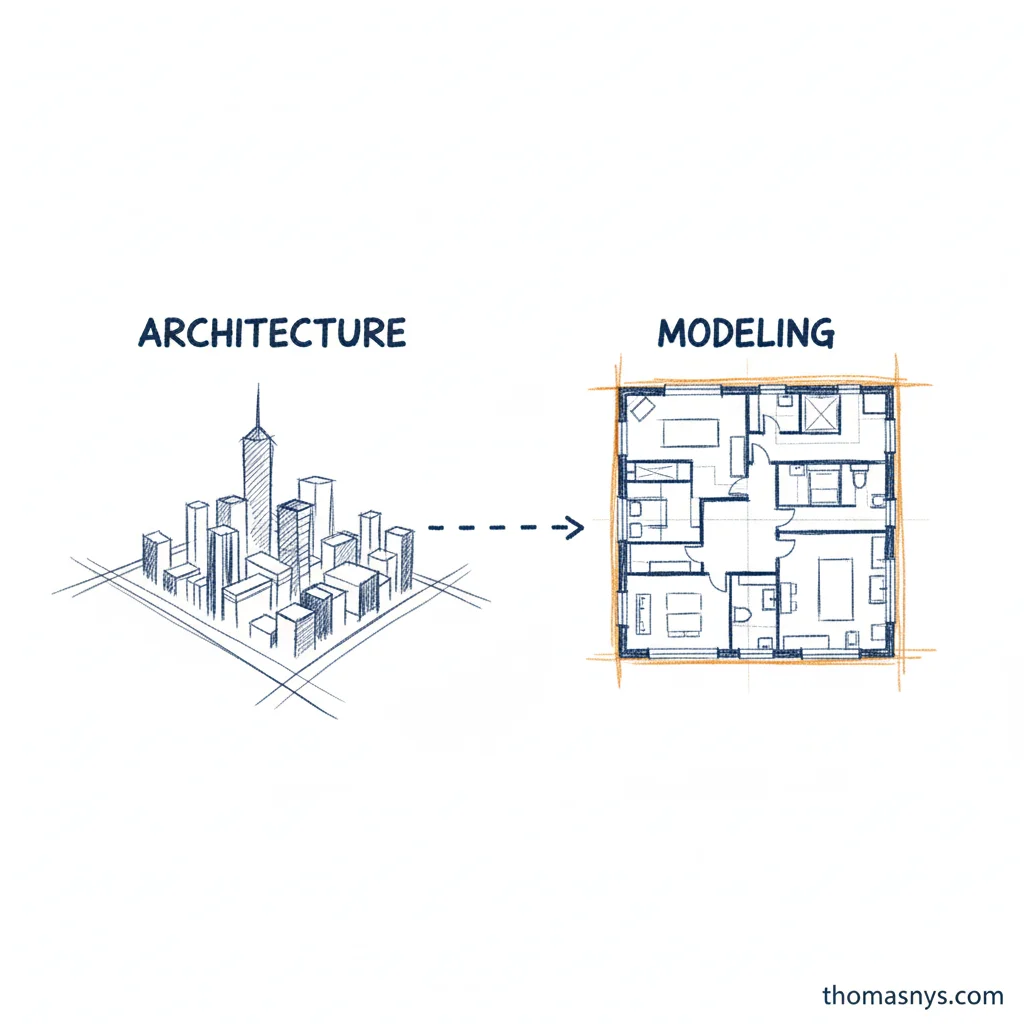
The Short Version
Data architecture is the big picture - how data flows across your organization, which systems exist, how they connect, and what standards apply.
Data modeling is the detail - how individual datasets are structured, what fields exist, how tables relate to each other.
Architecture decides you need a data warehouse. Modeling decides how tables inside that warehouse are organized.
Both matter. They operate at different levels of abstraction and require different skills.
Quick Comparison
| Aspect | Data Architecture | Data Modeling |
|---|---|---|
| Scope | Organization-wide systems | Individual datasets |
| Abstraction | High-level, strategic | Detailed, tactical |
| Focus | How systems connect | How tables relate |
| Deliverables | System diagrams, standards | ERDs, table definitions |
| Primary question | “What systems do we need?” | “How should data be structured?” |
| Time horizon | Years | Months to project lifecycle |
| Owner | Data architect | Data modeler or analyst |
The Key Difference
Scope
Architecture answers organizational questions:
- What systems do we need?
- How does data flow between them?
- Who owns what?
- What standards apply across the platform?
Modeling answers structural questions:
- What tables should exist?
- What columns belong in each table?
- How do tables relate to each other?
- How should we organize facts and dimensions?
Analogy
Think of building a city:
- Architecture is city planning - where neighborhoods go, how roads connect them, where utilities run
- Modeling is building design - how rooms are arranged inside each building, what goes where
You need both, but they’re different disciplines.
What Data Architecture Covers
Architecture operates at the system level:
Platform Decisions
- Data warehouse vs data lake vs lakehouse
- Which cloud provider and services
- Real-time vs batch processing
- Build vs buy for each component
Integration Patterns
- How data moves between systems
- ETL vs ELT approaches
- API patterns and contracts
- Event-driven vs scheduled pipelines
Governance Framework
- Data governance policies
- Access control patterns
- Quality standards
- Compliance requirements
Organizational Structure
- Team boundaries and ownership
- Centralized vs federated approaches
- How domains are divided
For more detail, see What Is Data Architecture?
What Data Modeling Covers
Modeling operates at the dataset level:
Schema Design
- Table structures and relationships
- Column definitions and data types
- Primary and foreign keys
- Constraints and validation rules
Modeling Patterns
- Dimensional modeling - Star schemas with fact and dimension tables
- Data vault - Hub, link, and satellite tables for flexibility
- Third normal form (3NF) - Normalized structures for transactional systems
- Wide tables - Denormalized for specific analytics use cases
Naming and Documentation
- Consistent naming conventions
- Field descriptions and business definitions
- Lineage within datasets
Performance Optimization
- Indexing strategies
- Partitioning schemes
- Clustering and sorting
- Materialized views
How They Relate
Architecture Contains Modeling Decisions
Architecture defines the framework within which modeling happens:
Architecture says “we use Snowflake with a dimensional model”
Modeling defines the specific star schemas within Snowflake
Architecture says “Bronze/Silver/Gold layers”
Modeling defines table structures at each layer
Architecture says “domain-owned datasets”
Modeling defines schemas within each domain
Modeling Informs Architecture
Modeling requirements can drive architectural decisions:
- Complex modeling needs might require specific platform capabilities
- Performance requirements might influence architecture choices
- Governance requirements affect how models are designed
The Feedback Loop
Good architecture makes modeling easier by providing:
- Clear standards to follow
- Appropriate tools for the job
- Defined boundaries and ownership
Good modeling validates architecture by showing whether:
- The platform supports needed structures
- Performance meets requirements
- Standards are practical to follow
Common Confusion Points
“We need better data modeling” vs “We need better architecture”
Symptoms that suggest modeling problems:
- Individual tables are poorly structured
- Queries against specific datasets are slow
- Business definitions are inconsistent within a domain
- Analysts struggle to join related tables
Symptoms that suggest architecture problems:
- Data is scattered across disconnected systems
- The same data exists in multiple places with different values
- Nobody knows how data flows through the organization
- Adding new data sources requires reinventing the wheel
Often, what looks like a modeling problem is actually an architecture problem. If every team models data differently because there are no standards, that’s architecture.
Role Confusion
Data architects focus on system-level design:
- What Is a Data Architect?
- Senior role, 10+ years experience typical
- Works across teams and stakeholders
- Concerned with platforms, integration, governance
Data modelers focus on dataset-level design:
- Often part of data engineering or analytics teams
- 3-10+ years experience typical
- Works within specific domains or projects
- Concerned with schemas, relationships, performance
Some people do both. In smaller companies, the same person often handles architecture and modeling. But they’re distinct skills.
When You Need Each
You Need Architecture When
- You’re building or redesigning your data platform
- Multiple teams need to share data
- You’re evaluating major technology changes
- Data is scattered and nobody owns the big picture
- Cloud costs are growing without clear value
You Need Modeling When
- You’re designing a new dataset or domain
- Existing models are causing performance problems
- Business definitions are inconsistent
- Analysts can’t find or understand the data they need
- You’re implementing a specific analytics use case
You Need Both When
- You’re building a data platform from scratch
- You’re modernizing a legacy system end-to-end
- You have architectural direction but no one to implement models
- Models exist but don’t fit together coherently
Modeling Within Architecture
Good architecture defines how modeling should happen:
Standards
Architecture should specify:
- Which modeling patterns to use (dimensional, data vault, etc.)
- Naming conventions for tables, columns, schemas
- Documentation requirements
- Testing and validation standards
Boundaries
Architecture should define:
- Which domains own which data
- Where transformation happens (Bronze → Silver → Gold)
- How shared entities are modeled across domains
- What interfaces exist between domains
Tools
Architecture should provide:
- Platforms that support needed modeling patterns
- Tooling for model documentation and discovery
- Testing frameworks for model validation
- Environments for model development
The Layered Approach
Many organizations separate architecture and modeling responsibilities:
Architecture Team/Role
- Defines platform and standards
- Reviews cross-domain modeling decisions
- Ensures consistency across the organization
- Handles integration and governance
Domain/Feature Teams
- Implement models within their area
- Follow architectural standards
- Own quality within their domain
- Propose changes when standards don’t fit
This separation works because:
- Architecture decisions are infrequent but high-impact
- Modeling decisions are frequent but localized
- Different skills are emphasized at each level
Getting Help
If you’re not sure whether you have an architecture problem or a modeling problem, architecture advisory can help assess your situation and determine the right approach.
For ongoing architecture direction, a fractional data architect provides senior guidance without a full-time hire - including establishing modeling standards that teams can follow.
Frequently Asked Questions
What is the difference between data architecture and data modeling?
Which comes first: data architecture or data modeling?
Can one person do both data architecture and data modeling?
How do I know if I have an architecture problem or a modeling problem?
What modeling patterns does data architecture specify?
Related Reading
- What Is Data Architecture? - The big picture discipline
- What Is a Data Architect? - The role that owns architecture
- Data Architecture vs Data Engineering - Another common confusion
- Data Architecture Principles - Guidelines that apply to both
- Data Governance Framework - Structure for implementing governance
- Data Strategy Roadmap - Implementation planning
- Why Data Architecture Matters for Startups - When to start thinking about architecture
- Why Your Lakehouse Became a Swamp - When modeling without architecture fails