Why data architecture principles matter
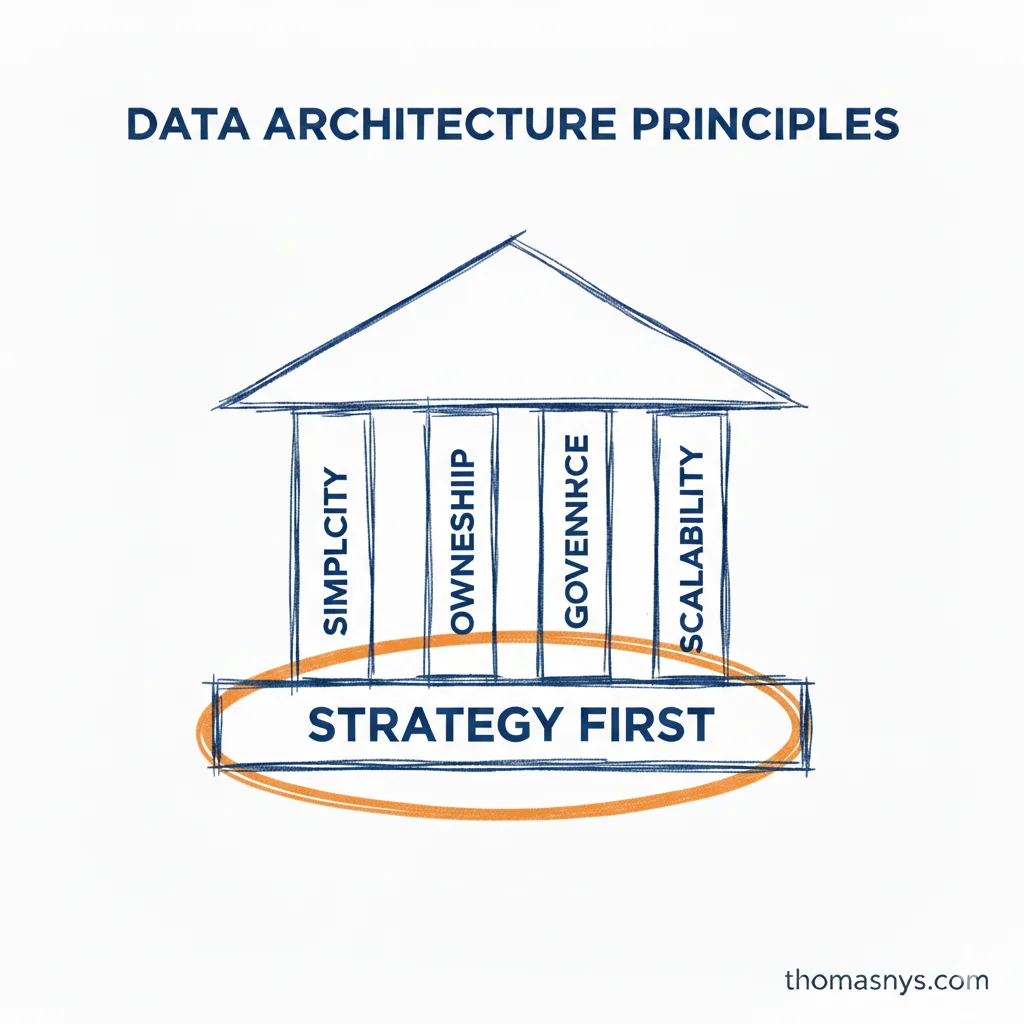
Data architecture principles are decision-making shortcuts. When you’re choosing between options, good principles tell you which trade-offs align with your goals.
Without them, the same argument runs again on every decision, with whoever is most insistent winning. With them, the criteria are written down and the discussion is shorter.
These are practical guidelines drawn from 10+ years of building and fixing data platforms. Each one addresses a problem that shows up repeatedly.
For background on what data architecture actually is, see What Is Data Architecture?
Sorting a change before you apply the principles
Principles decide how to build something. Before that, sort the change itself, because most changes don’t need the full treatment.
I ask two questions: how many consumers does this touch, and can we undo it by Friday? A consumer is anything that breaks when the thing changes: a dashboard, a downstream job, a model, a partner’s extract. Query logs and lineage will give you the count, and in the reviews I’ve run it has usually been higher than the team guessed.
The answers put the change in one of four boxes:
- Few consumers, easy to undo. Just do it. Swapping a linter or a small internal job doesn’t need a meeting.
- Many consumers, easy to undo. Pilot it with one team, then widen. A new BI tool running next to the old one lives here.
- Few consumers, hard to undo. Write it down on one page: why you picked that storage format, and what you rejected. Future maintainers need the reasoning more than the decision.
- Many consumers, hard to undo. These earn a full architecture review. Warehouse moves, orchestrator swaps, changing the customer ID.
Borderline cases go up a box. The cost of over-reviewing a small change is one meeting, and the cost of under-reviewing a large one lands much later.
The core principles
1. Own before you build
Every dataset needs an owner before it exists.
Orphaned data is the failure I meet most often: datasets that land without anyone accountable for their quality, meaning, or lifecycle.
Ownership means:
- Someone defines what the data means
- Someone monitors quality
- Someone decides who can access it
- Someone fixes issues when they occur
Data without ownership decays. Give it long enough and nobody knows what it means, whether it’s accurate, or whether it’s safe to delete.
Apply it: Before creating any new dataset, pipeline, or table - assign an owner. Put their name in the metadata. Make them accountable.
2. Design for change
Your architecture will change. Design so it can.
Requirements move: a new source system, a new consumer, a regulation that arrives with a deadline, ten times the volume. An architecture that assumes stability gets brittle in exactly those moments.
This means:
- Loose coupling between components
- Clear interfaces between systems
- Avoiding tight dependencies on specific tools
- Building in layers that can change independently
Aim to be able to adapt without starting over. First-time perfection is not available at the point where you have to decide.
Apply it: Ask “what happens when this changes?” for every major decision. If the answer is “we rebuild everything,” reconsider the approach.
3. Optimize for understanding
Simple systems that everyone understands beat clever systems only experts can maintain.
The genius architecture that only one person can operate is a liability. When that person leaves - and they will - you’re stuck with a system nobody can safely modify.
Complexity has costs:
- Longer onboarding for new engineers
- Higher risk of mistakes
- Slower debugging
- More expensive maintenance
If you can’t explain in one sentence why a layer is there, that’s a reason to look at whether it should be.
Apply it: a new engineer should be able to follow your architecture early in their first weeks. If it takes them months, simplify it.
4. Push quality upstream
Catch problems as early as possible in the data flow.
Errors are cheapest to fix near the source. Validation and transformation can improve data on the way through, but a problem caught three systems later has already been copied into places nobody has listed.
Quality gates should exist at:
- Ingestion: Validate schema and basic rules on entry
- Transformation: Check business logic during processing
- Delivery: Verify outputs meet consumer expectations
When bad data makes it to dashboards, trust erodes. Rebuilding trust costs more than preventing the problem.
Apply it: Every pipeline should have explicit quality checks. When checks fail, the pipeline should stop or alert - not silently pass garbage downstream.
5. Make costs visible
If you can’t see what something costs, you can’t optimize it.
Cloud platforms make it easy to spend money invisibly: a query that scans far more than it reads, storage that only ever grows, a pipeline still running for a dashboard nobody opens.
Cost visibility requires:
- Tagging resources by team, project, or use case
- Monitoring spend trends, not just totals
- Attribution so teams feel the cost of their decisions
- Regular review of what’s running and why
Most architecture decisions have a monthly bill attached, so put the number next to the decision when you make it.
Apply it: Every team should see their data costs monthly. Make cost a first-class metric alongside performance and reliability.
6. Separate concerns by lifecycle
Data at different stages has different requirements. Design accordingly.
Raw data, processed data, and consumer-ready data have different:
- Update frequencies
- Quality requirements
- Access patterns
- Retention needs
Mixing them creates conflicts: one storage layout rarely serves both a real-time query pattern and a long-term archive well. Tiering and workload separation let one platform cover both, as long as the boundary is deliberate.
This is why patterns like medallion architecture (bronze, silver, gold) exist: they separate data by how refined it is and what it’s ready for.
Apply it: Organize storage and processing by data stage, not just by source. Make the boundaries explicit.
7. Write the contract down
Explicit agreements between producers and consumers prevent surprises.
When a producer changes a schema, a timing, or the meaning of a field without telling consumers, jobs fail at 3am. The producer documented it somewhere. The consumer never saw it.
Data contracts make agreements explicit:
- What fields exist and what they mean
- What quality guarantees apply
- What the update schedule is
- How breaking changes are communicated
A contract is the minimum structure that lets two teams change their own systems without breaking each other’s. It reduces surprises; it doesn’t remove them.
Apply it: for any data shared between teams, write the contract down and make the consumer list visible to whoever is making the change.
8. Govern proportionally
Match governance to risk and value.
Not all data is equal. Customer PII needs strict governance. Internal metrics can be looser. Applying the same rigor everywhere creates overhead without benefit.
Data governance should scale with:
- Sensitivity (PII, financial, regulated data)
- Business criticality (board reports vs exploratory analysis)
- Breadth of use (one team vs company-wide)
Heavy governance on low-value data slows everything down. Light governance on critical data creates risk.
Apply it: Classify data by sensitivity and criticality. Apply governance proportionally.
9. Automate what repeats
Automate the work that repeats, once the cost of automating is below the cost of repeating.
Manual processes don’t scale, and they drift: different people do them differently, the documentation goes stale, the knowledge leaves with someone. Frequency, risk, and effort decide whether automating a given task pays.
Automate:
- Pipeline execution and monitoring
- Quality checks and alerts
- Access provisioning
- Documentation generation
Reserve manual work for genuinely one-time tasks and decisions requiring judgment.
Apply it: when someone does something manually, ask how often it recurs and what a mistake costs. Weekly and risky is worth automating; annual and harmless usually isn’t.
10. Build for recovery
Failures will happen. Design so you can recover quickly.
You can’t prevent all failures. Networks fail, vendors have outages, bugs slip through, humans make mistakes. The question isn’t whether something will break - it’s how fast you can fix it.
Recovery capability requires:
- Idempotent pipelines that can safely re-run
- Point-in-time recovery for storage
- Clear runbooks for common failures
- Monitoring that detects problems early
Prevention is worth the investment. Recovery time is what you’ll be judged on during the incident.
Apply it: For every critical system, ask: if this fails at 3am, how long to recover? If the answer is “we don’t know,” that’s your next priority.
Applying the principles
Once a change is in the right box, the principles are the lenses for the decision itself: which option is simpler to understand, which adapts better, which makes its costs visible, which catches problems earlier.
A worked example. A team wants to move their event tables from JSON files on object storage to a columnar table format. The query logs show 14 downstream jobs and 3 dashboards reading them, and the change rewrites the write path, so the old files stop being produced. Many consumers, hard to undo: it earns a review rather than a ticket.
Inside that review the principles do the work. Own before you build says name the owner of the new tables before the migration starts. Design for change says keep the old path writing in parallel until consumers have moved, so a rollback is a switch rather than a rebuild. Make costs visible says price the new format’s storage and query cost against a month of the current bill before committing. Push quality upstream says add the schema check at ingestion now, while someone is already in that code.
What comes out is usually a smaller change than the one that went in, with a rollback attached.
When to get help
Applying principles consistently across a growing organization is hard. Teams have competing priorities, legacy systems have constraints, and there’s never enough time.
A fractional data architect can help establish principles and ensure they’re applied consistently. For specific decisions, architecture advisory provides guidance on how principles apply to your situation.
Frequently asked
What are data architecture principles?
Why are data architecture principles important?
What is the most important data architecture principle?
How do you apply data architecture principles?
What happens when data architecture principles are ignored?
Related reading
- What Is Data Architecture? - The fundamentals these principles apply to
- What Is a Data Architect? - The role that applies these principles
- What Is Data Governance? - Principle #8 in depth
- Red Flags: Symptoms of Poor Architecture - What happens when principles are ignored
- The Architecture Decisions You Can’t Reverse - Why principle #2 matters
- Why Your Lakehouse Became a Swamp - Principle #1 in action
Fractional Data Architect helping startups and scaleups build data platforms that scale.
More about Thomas Nys →