The Short Version
Building a data team is harder than building most engineering teams. The roles are less defined, the skills more varied, and the organizational placement more contested.
Most companies make the same mistakes:
- Hiring for the wrong role at the wrong time
- Expecting one person to do three jobs
- Placing data teams where they can’t succeed
- Scaling headcount without scaling structure
The result: expensive teams that underdeliver, talented people who burn out, and leadership that loses faith in “data.”
Building a data team that works requires understanding what you actually need, hiring deliberately, and structuring for your current stage - not the stage you hope to reach.
When Do You Need a Data Team?
Not every company needs a dedicated data team. Signs you might:
Data is becoming critical
- Business decisions require data analysis, not just gut feel
- Stakeholders are asking questions you can’t answer
- Manual reporting is consuming significant time
- Data quality issues are causing business problems
Complexity is growing
- Multiple data sources need integration
- Self-serve analytics isn’t scaling
- Compliance/governance requirements are increasing
- Real-time data needs are emerging
Current approaches are breaking
- Analysts are doing engineering work (poorly)
- Engineers are doing analytics work (reluctantly)
- Everyone is building their own dashboards (inconsistently)
- Nobody trusts the numbers
If you’re seeing three or more of these, you probably need dedicated data capability.
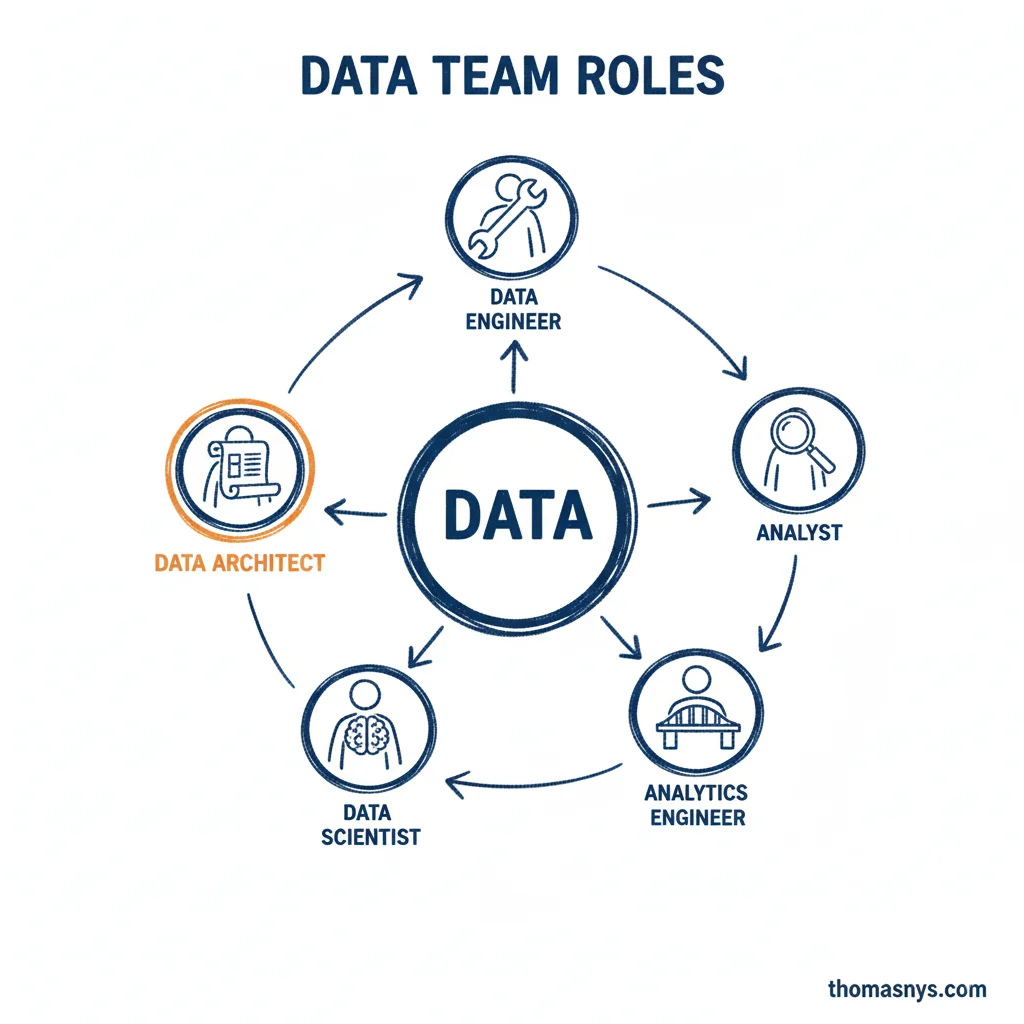
Core Data Team Roles
Data Engineer
What they do: Build and maintain the infrastructure that moves and transforms data. Pipelines, warehouses, orchestration, reliability.
Key skills: SQL, Python, ETL/ELT tools (dbt, Airflow, etc.), cloud platforms, software engineering fundamentals.
When you need them: When you have data sources that need integration, when analysts are struggling with data quality, when your data infrastructure needs to be reliable rather than scrappy.
Learn more: What is a Data Engineer?
Data Analyst
What they do: Answer business questions with data. Reports, dashboards, ad-hoc analysis, stakeholder support.
Key skills: SQL, BI tools (Looker, Tableau, etc.), business acumen, communication, statistical thinking.
When you need them: When business teams need regular insights, when ad-hoc questions are frequent, when you need to translate data into decisions.
Analytics Engineer
What they do: Bridge between engineering and analysis. Build clean, documented data models that analysts can use confidently. Transform raw data into reliable datasets.
Key skills: SQL, dbt, data modeling, documentation, testing. Understanding of both engineering rigor and business needs.
When you need them: When analysts are struggling with messy data, when you have multiple analysts who need consistent foundations, when data quality is a concern.
Data Scientist
What they do: Build predictive models, run experiments, find patterns that aren’t obvious from dashboards. Statistical and machine learning work.
Key skills: Statistics, ML, Python/R, experimentation, problem framing.
When you need them: When you have enough data to learn from, when prediction would create business value, when simple analytics isn’t enough.
Warning: Most companies hire data scientists too early. If you don’t have clean data and clear problems, a data scientist will spend their time on data engineering (which they’ll do poorly) or leave frustrated.
Data Architect
What they do: Design the overall data platform - what systems you need, how they connect, what standards apply. Strategic decisions that affect multiple teams.
Key skills: Systems thinking, broad technical knowledge, stakeholder management, long-term planning.
When you need them: When your data platform is becoming complex, when you’re making decisions that will be hard to reverse, when you need someone thinking about the whole system rather than individual pieces.
Learn more: What is a Data Architect?
Common Hiring Mistakes
The Unicorn Hunt
“We need someone who can build pipelines, create dashboards, run ML models, and present to the board.”
That person doesn’t exist. Or if they do, they won’t stay long because you’re asking them to do four jobs.
Hire for the role you most need now. Add complementary roles as you grow.
Hiring Wrong
- Hiring data scientists when you need data engineers
- Hiring senior when you need to build foundations first
- Hiring junior when you need someone who can operate independently
- Hiring for skills without checking for fit
The Solo Data Person Trap
One person handling all data needs for a 50+ person company. They’re spread across so many responsibilities that nothing gets done well.
If you can only hire one person, be explicit about what they will and won’t do. Accept trade-offs rather than pretending one person can do everything.
Title Inflation
Calling everyone “senior” or “lead” because it helps with recruiting. Until you need to hire an actual lead and the title is already taken.
Titles should mean something. Use them thoughtfully.
Running a Disciplined Hiring Process
Most mis-hires trace back to a fuzzy process, not bad luck. Tighten four things and the hit rate climbs:
Define the role before you write anything. Data engineer vs analytics engineer vs architect vs head of data are different jobs. Map what your platform actually needs against what you already have, then name the one role that closes the biggest gap.
Write the job description for practitioners, not ATS filters. Describe the work and the problems they’ll own, not a wishlist of twenty tools. The right people self-select on the work.
Interview with a scorecard. Structured technical assessment and the same evaluation criteria for every candidate. Consistency is what makes the comparison meaningful, and it’s what stops you hiring on charisma.
Plan the onboarding before they start. A 30/60/90-day plan turns a new hire productive faster: learn the codebase and ship a first PR in the first month, own a small project by 60 days, contribute independently by 90.
A single wrong senior hire costs €50-100K+ once you add recruiting, ramp, team disruption, and the repeat search. The process above costs a fraction of that and prevents the mistake.
Bringing in Senior Capacity
Sometimes the gap is seniority, not a missing seat on the org chart: complex pipeline work keeps stalling, technical debt is accumulating, and your juniors need mentoring your seniors are too stretched to give. You need senior hands, but not always a full-time hire.
| Option | Trade-off |
|---|---|
| Full-time senior hire | Long recruiting, full commitment, right for permanent core needs |
| Contractor | Delivers isolated work then leaves, little knowledge transfer |
| Fractional senior capacity | Senior output plus mentoring a few days a week, scales with need |
Whichever you choose, senior capacity should leave the team stronger, not more dependent: shipping the complex work, raising the bar through code review, and pairing on hard problems so the knowledge stays after the engagement ends. Hands-on senior engineering is part of what a Fractional Data Architect engagement delivers alongside the architecture direction.
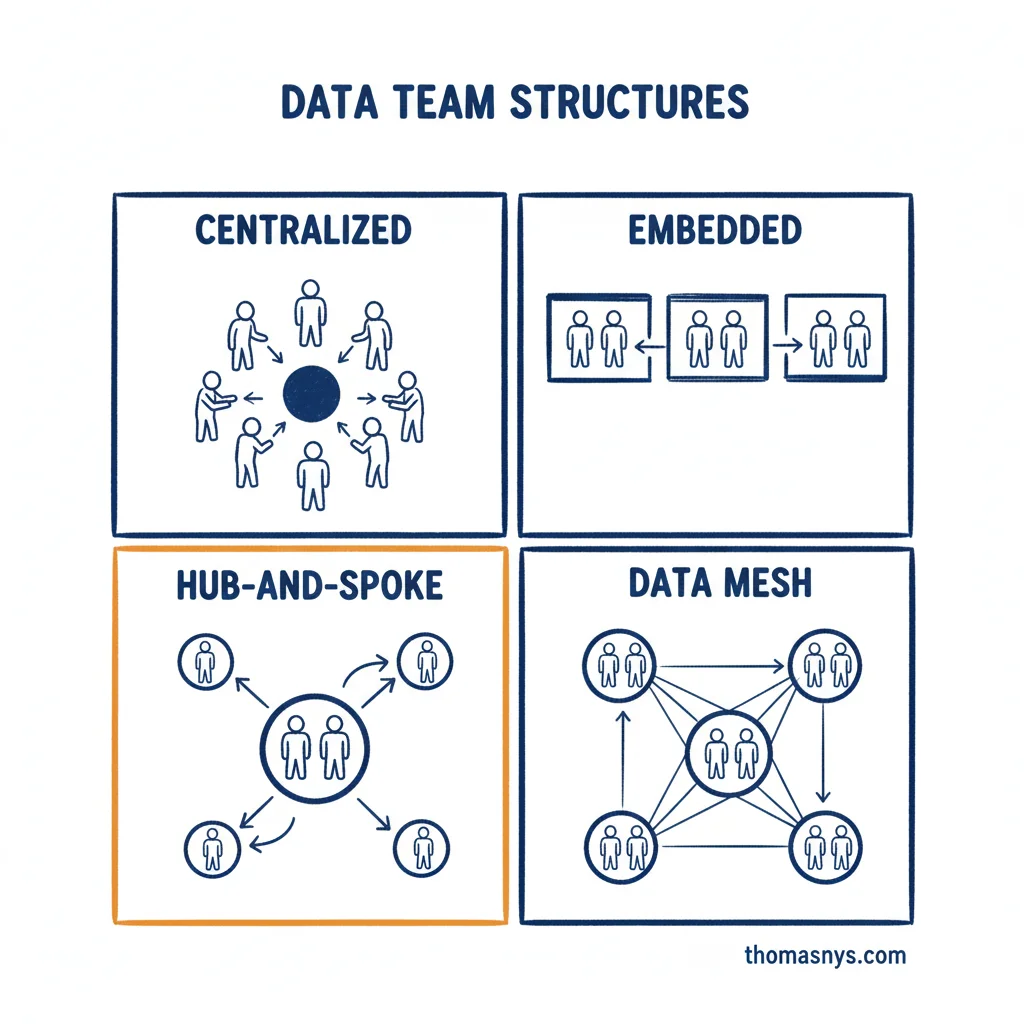
Team Structure Options
Centralized
One data team serves the whole company.
Pros: Consistency, efficiency, career paths, shared standards. Cons: Can become bottleneck, may lack business context, prioritization conflicts. Works when: Company is small enough that one team can serve everyone, or data work is specialized enough to benefit from concentration.
Embedded
Data people sit within business teams (marketing data person, finance data person, etc.).
Pros: Deep business context, fast response to team needs, strong relationships. Cons: Inconsistent practices, duplicated work, isolation from data peers, career path unclear. Works when: Business contexts are very different, speed of response matters more than consistency.
Hub and Spoke (Hybrid)
Central team handles infrastructure and standards. Embedded analysts serve specific business areas but report into the hub.
Pros: Balance of consistency and responsiveness, clear career paths, shared infrastructure with local context. Cons: Matrix management complexity, potential for conflict, requires strong coordination. Works when: Company is large enough to need both consistency and specialization.
Data Mesh
Domain teams own their own data products. Central team provides platform and standards.
Pros: Scales with organization, aligns data with business ownership. Cons: Requires organizational maturity, can create silos if poorly implemented, coordination overhead. Works when: Domains are truly independent and mature enough to own data quality.
Learn more: Data Mesh vs Reality
Scaling Stages
Stage 1: First Hire (1 person)
Usually a data engineer or analytics engineer who can build foundations.
Focus: Get data flowing reliably. Don’t try to do everything. Avoid: Hiring a data scientist first (they need foundations to work on).
Stage 2: Small Team (2-4 people)
Add complementary roles. If you started with engineering, add analysis. Vice versa.
Focus: Cover the core needs. Build processes that will scale. Avoid: Everyone doing everything. Define responsibilities clearly.
Stage 3: Growing Team (5-10 people)
Specialization becomes possible and necessary. Consider adding leads.
Focus: Create career paths. Establish standards. Think about structure. Avoid: Growing without structure. Every hire should have clear role.
Stage 4: Scaling (10+ people)
Structure matters enormously. The choices you make now compound.
Focus: Platform thinking. Enable rather than do. Build leverage. Avoid: Becoming a bottleneck. The goal is enabling the organization, not controlling data.
Warning Signs of Team Dysfunction
Burnout
- Constant firefighting
- Unrealistic expectations
- No time for improvement
- Key people leaving
Usually a sign of under-resourcing, poor prioritization, or organizational dysfunction - not individual failure.
Hero Dependency
- One person knows everything
- Decisions wait for specific individuals
- Vacation causes panic
Build systems that don’t require heroes. Document. Cross-train. Share context.
Analysis Paralysis
- Everything requires extensive analysis
- No decisions get made
- Data becomes a blocker rather than enabler
Data should accelerate decisions, not prevent them.
Tool Obsession
- More energy on tools than outcomes
- Constant churn between platforms
- “We just need the right stack”
Tools matter, but they’re not the problem. Focus on outcomes.
Getting Outside Help
If you’re building or growing a data team, outside help can speed it up and de-risk the early hires:
Fractional Data Architect
Senior leadership while you build the team: someone who defines the roles you actually need, makes the architecture decisions, mentors early hires, and keeps standards consistent as the team grows.
Related Reading
Hiring and Team Dynamics
- You’re Hiring Data Engineers Wrong
- Why Your Best Engineers Leave
- We Hired a 10x Developer, Then We Lost the Team
- The Genius Developer Anti-Pattern
Team Burnout and Sustainability
- Why Your Data Team Is Burned Out
- Hero Dependency
- The Destabilizing Effect of Constant Org Chart Shuffles
Team Structure
- Team Structure Shapes Delivery Speed
- Data Mesh vs Reality
- Data Team Ownership: Resolving Cross-Team Friction
Related Topics
- Data Architecture vs Data Engineering - Clarifying role confusion
- What Is Data Architecture? - What architects actually do
- What Is Technical Debt? - How team structure affects debt accumulation
- AI & Data Architecture - Building teams for AI initiatives
Get Help
Building a data team is high-stakes. The wrong hires or structure can set you back months or years.
If you’re planning to build or restructure your data team, book a call to discuss your situation. No pitch - just an honest conversation about what you actually need.
Fractional Data Architect helping startups and scaleups build data platforms that scale.
More about Thomas Nys →