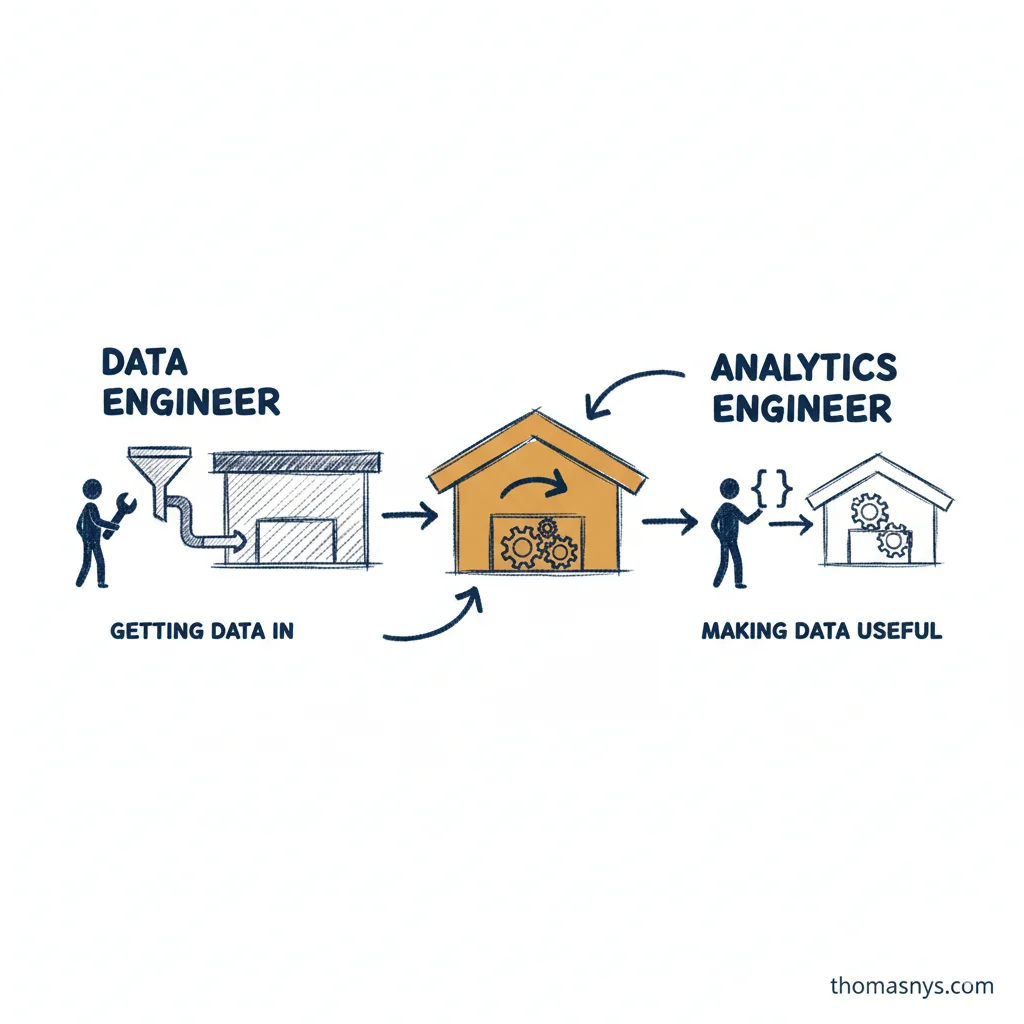
Analytics Engineer vs Data Engineer: The Short Version
Data engineers build and maintain the infrastructure that moves data - ingestion pipelines, orchestration, platform reliability. They work across the entire data stack, from source systems to data warehouse.
Analytics engineers transform data inside the warehouse to make it useful for analysis. They model data, write business logic, and create the datasets analysts actually use. They work primarily in SQL and tools like dbt.
The simplest distinction in the analytics engineer vs data engineer comparison: data engineers get data into the warehouse. Analytics engineers make that data useful once it’s there.
Both roles emerged from what used to be called “data engineering” - but as the field matured and tools improved, the work split into two distinct specializations.
What Data Engineers Do
Core Responsibilities
- Build ingestion pipelines - Extract data from source systems (databases, APIs, files, streams) and load it into the data warehouse or lake
- Maintain infrastructure - Manage orchestration tools (Airflow, Dagster), compute resources, storage systems
- Ensure reliability - Monitor pipelines, handle failures, maintain SLAs for data freshness
- Scale systems - Optimize performance as data volumes grow, manage costs
- Integrate systems - Connect new data sources, handle schema changes, manage data contracts with source teams
Typical Tools
- Languages: Python, SQL, sometimes Scala/Java
- Orchestration: Airflow, Dagster, Prefect
- Processing: Spark, custom Python scripts
- Ingestion: Fivetran, Airbyte, custom connectors
- Infrastructure: Docker, Kubernetes, Terraform
- Cloud: AWS, GCP, Azure services
Day-to-Day Work
A data engineer’s week might include:
- Debugging why a pipeline failed at 3 AM
- Building a new connector for a third-party API
- Optimizing a Spark job that’s getting too slow
- Setting up monitoring for a new data source
- Migrating pipelines to a new orchestration tool
- Working with source system teams on upstream changes
What Analytics Engineers Do
Core Responsibilities
- Transform data - Write SQL transformations that turn raw data into clean, modeled datasets
- Model data - Design dimensional models, fact tables, and marts that serve business needs
- Define metrics - Implement business logic for KPIs and metrics in code
- Document data - Create and maintain data documentation, definitions, and lineage
- Enable self-service - Build datasets that analysts can query without engineering help
- Ensure quality - Write tests that validate data accuracy and completeness
Typical Tools
- Primary: dbt (the defining tool of the role)
- Languages: SQL (primarily), some Python
- Warehouses: Snowflake, BigQuery, Databricks, Redshift
- BI tools: Looker, Tableau, Metabase
- Version control: Git
- Documentation: dbt docs, data catalogs
Day-to-Day Work
An analytics engineer’s week might include:
- Adding a new metric to the core business model
- Writing tests for a transformation that had quality issues
- Reviewing a PR for a new dimensional model
- Meeting with finance to understand how they calculate churn
- Debugging why a dashboard is showing unexpected numbers
- Documenting business logic for a new data mart
Key Differences
| Aspect | Data Engineer | Analytics Engineer |
|---|---|---|
| Focus | Infrastructure and pipelines | Transformation and modeling |
| Scope | Full data stack | Warehouse/transformation layer |
| Primary language | Python + SQL | SQL (with some Python) |
| Core tool | Orchestrator (Airflow, etc.) | dbt |
| Works with | Platform, DevOps, source teams | Analysts, business stakeholders |
| Output | Data in the warehouse | Data ready for analysis |
| Failure mode | Data doesn’t arrive | Data arrives but is wrong/unusable |
Skills Comparison
Data Engineer Skills
Must have:
- Strong Python programming
- SQL proficiency
- Understanding of distributed systems
- Experience with cloud platforms
- Debugging and troubleshooting
Nice to have:
- Streaming experience (Kafka, Kinesis)
- Infrastructure as code (Terraform)
- Container orchestration (Kubernetes)
- Data modeling fundamentals
Analytics Engineer Skills
Must have:
- Advanced SQL
- dbt proficiency
- Understanding of data modeling
- Business context and communication
- Git and version control
Nice to have:
- Python for light scripting
- BI tool experience
- Statistics and analytics background
- Domain expertise
The Rise of Analytics Engineering
Analytics engineering emerged around 2016-2019 as:
- Cloud warehouses made in-warehouse transformation cheap and fast
- dbt provided a framework for SQL-based transformation with software engineering practices
- ELT replaced ETL - load raw data first, transform after
- Analysts learned SQL but struggled with engineering practices
- Data engineers were bottlenecks - too much demand, too few people
The analytics engineer role filled the gap between “analyst who knows SQL” and “engineer who can build pipelines.” It brought software engineering rigor (version control, testing, documentation) to analyst-friendly SQL transformation.
When You Need Each Role
You need a data engineer when:
- Data isn’t getting into your warehouse reliably
- You’re building new integrations with source systems
- Pipeline reliability is a problem
- You need streaming or real-time data
- Infrastructure needs scaling or optimization
- You’re building a data platform from scratch
You need an analytics engineer when:
- Data is in the warehouse but analysts can’t use it
- Business logic is scattered across dashboards and spreadsheets
- Metrics aren’t consistent across reports
- Analysts spend too much time on data preparation
- You need documentation and testing for transformations
- Self-service analytics is a goal
You might need both when:
- Building a complete modern data stack
- Scaling a data team beyond 3-4 people
- Data complexity requires specialization
- You have both infrastructure and modeling challenges
Team Structures
Small Teams (1-3 people)
One person often does both. Titles like “data engineer” or “senior data engineer” cover the full scope. The work leans toward whatever’s most painful - usually reliability first, then modeling.
Growing Teams (4-8 people)
Specialization emerges. Some engineers focus on infrastructure and reliability. Others focus on transformation and modeling. Titles start to differentiate.
Larger Teams (8+ people)
Clear separation between:
- Data platform / Infrastructure engineers - core systems
- Data engineers - pipelines and integrations
- Analytics engineers - transformation and modeling
Sometimes analytics engineers report to a different team (analytics, BI) than data engineers (platform, engineering).
Career Paths
Data Engineer → Analytics Engineer
Common for engineers who:
- Prefer working closer to business problems
- Enjoy SQL more than Python/infrastructure
- Want more interaction with stakeholders
- Find pipeline work repetitive
Analytics Engineer → Data Engineer
Common for engineers who:
- Want to work on harder technical problems
- Enjoy infrastructure and systems work
- Want broader scope beyond the warehouse
- Find transformation work limiting
Both → Data Architect
Senior practitioners from either path can move into architecture roles - designing systems rather than building them. Analytics engineers often bring stronger business context; data engineers bring deeper technical breadth.
Common Misconceptions
“Analytics engineers are just SQL analysts”
No. Analytics engineers bring software engineering practices to SQL - version control, testing, documentation, code review. They design data models, not just write queries.
“Data engineers don’t need SQL”
SQL is still essential for data engineers. They work with warehouses, debug data issues, and often write transformations. Strong SQL is a must-have, not a nice-to-have.
“Analytics engineering is easier”
Different, not easier. Analytics engineering requires deep business understanding, careful data modeling, and attention to detail that catches subtle logic errors. It’s intellectually demanding work.
“These roles should be combined”
At scale, specialization improves quality. Pipeline reliability and data modeling require different skills and different feedback loops. Forcing one person to do both usually means both suffer.
Frequently Asked Questions
What is the difference between analytics engineer and data engineer?
What does an analytics engineer do?
What tools do analytics engineers use?
What skills do data engineers need?
Do I need both roles on my team?
Can you transition from data engineer to analytics engineer?
What is the salary difference between analytics engineer and data engineer?
Is analytics engineering easier than data engineering?
Related Reading
- What Is a Data Engineer? - Deep dive on the data engineer role
- What Is Data Engineering? - The broader discipline
- What Is a Data Architect? - The role that designs what both roles build
- What Is a Data Platform? - The system both roles contribute to
- Data Architecture vs Data Engineering - Another common comparison
- You’re Hiring Data Engineers Wrong - Hiring guidance for data roles